
Rationalizing Denominators Demo
Loading the math board and drawing, please wait…
This example demonstrates how to rationalize denominators using GeoGebra, visually illustrating the mathematical process. It involves core concepts like fraction simplification, radical operations, and algebraic transformations. Key GeoGebra commands used include Element, LaTeX, Text for text elements, questionList and questionListIndex for managing question lists, and interactive objects like cmark and TryAnother for answering questions. Variables such as A1, B1, C1 store answer data. Suitable for high school mathematics teaching to help students understand rationalization techniques and improve problem-solving skills.
GeoGebra Commands & Parameters
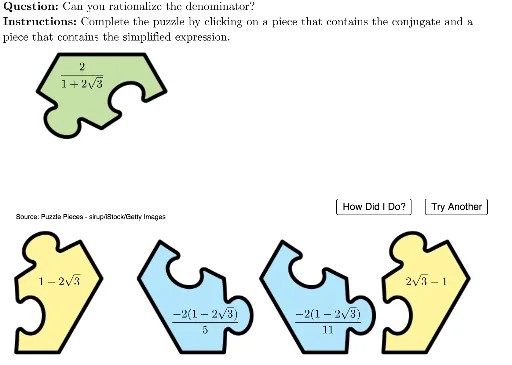
Element(questionList, questionListIndex) → questionNumLaTeX(UnicodeToLetter[10003]) → cmarkLaTeX(UnicodeToLetter[10007]) → xmarkElement(B2:B7, questionNum) → correctRightTextElement(C2:C7, questionNum) → correctLeftTextElement(D2:D7, questionNum) → incorrectRightTextElement(E2:E7, questionNum) → incorrectLeftTextLaTeX((((("\text{" * QUESTION) * "\\") * INSTRUCTIONS) * "}")) → TEXTLaTeX("\dfrac{5\sqrt{2}}{4-2\sqrt{3}}") → A2LaTeX("4+2\sqrt{3}") → B2LaTeX("\dfrac{5\sqrt{2}(2+\sqrt{3})}{2}") → C2LaTeX("2\sqrt{3}-4") → D2LaTeX("5\sqrt{2}(1+2\sqrt{3})") → E2LaTeX("\dfrac{4}{1+\sqrt{3}}") → A3LaTeX("1-\sqrt{3}") → B3LaTeX("-2(1-\sqrt{3})") → C3LaTeX("\sqrt{3}-1") → D3LaTeX("4-\sqrt{3}") → E3LaTeX("\dfrac{1-\sqrt{2}}{1+\sqrt{2}}") → A4LaTeX("1-\sqrt{2}") → B4LaTeX("-(1-\sqrt{2})^2") → C4LaTeX("\sqrt{2}-1") → D4LaTeX("(1-\sqrt{2})^2") → E4LaTeX("\dfrac{2}{1+2\sqrt{3}}") → A5LaTeX("1-2\sqrt{3}") → B5LaTeX("\dfrac{-2(1-2\sqrt{3})}{11}") → C5LaTeX("2\sqrt{3}-1") → D5LaTeX("\dfrac{-2(1-2\sqrt{3})}{5}") → E5LaTeX("\dfrac{6\sqrt{3}}{3+\sqrt{3}}") → A6LaTeX("3-\sqrt{3}") → B6LaTeX("\sqrt{3}(3-\sqrt{3})") → C6LaTeX("-3-\sqrt{3}") → D6LaTeX("2\sqrt{3}(1-\sqrt{3})") → E6LaTeX("\dfrac{3-\sqrt{2}}{2-\sqrt{2}}") → A7LaTeX("2+\sqrt{2}") → B7LaTeX("\dfrac{4+\sqrt{2}}{2}") → C7LaTeX("-2+\sqrt{2}") → D7LaTeX("\dfrac{2+\sqrt{2}}{2}") → E7Element(A2:A7, questionNum) → questionTextElement(F2:F7, questionNum) → feedbackText(If[isLeftCorrect, correctLeftText, incorrectLeftText], puzzleAnchor + (3, 4.5), true, true) → matchedLeftTextText(If[isRightCorrect, correctRightText, incorrectRightText], puzzleAnchor + (9.65, 7.5), true, true) → matchedRightText
AI Drawing Prompt Reference
Create a demonstration graphic for rationalizing denominators, including 7 questions. Each question has a fraction expression that needs to be rationalized, along with two possible answers. For example, the first question's expression is 5√2/(4-2√3), with possible answers of 4+2√3 and 2√3-4. The correct answer is 4+2√3, which rationalizes to 5√2(2+√3)/2. Repeat this process for the other 6 questions, placing the correct and incorrect answers on the left and right sides respectively, with the correct answer marked in green and the incorrect answer in red.
The prompt above was compiled from the original drawing commands and is for reference only.