
Radians to Revolutions
Loading the math board and drawing, please wait…
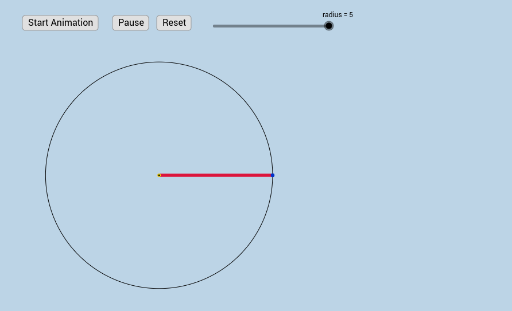
This applet illustrates that 2π radians equal one full revolution. Key mathematical concepts include radian measure and rotation angles. Using GeoGebra commands like Rotate, Angle, and CircleArc, students can visually understand the relationship between radians and rotations. Suitable for middle school and above students learning geometry and trigonometry.
GeoGebra Commands & Parameters
Center(c) → BRotate(A, 1, B) → A'Angle(A, B, A') → αRotate(A', 1, B) → A''Angle(A', B, A'') → βRotate(A'', 1, B) → A'''Angle(A'', B, A''') → γRotate(A''', 1, B) → CAngle(A''', B, C) → δRotate(C, 1, B) → C'Angle(C, B, C') → εRotate(C', 1, B) → C''Angle(C', B, C'') → ζCircleArc(B, A, A') → dCircleArc(B, A', A'') → eCircleArc(B, A'', A''') → fCircleArc(B, A''', C) → gCircleArc(B, C, C') → hCircleArc(B, C', C'') → kRotate(A, If[0 ≤ a ≤ 1, (a * α), α], B) → A'_1CircleArc(B, A, A'_1) → pDilate(B, If[0 ≤ a ≤ 1, 1 - a, 0], A) → B'Segment(B', A) → bCircleArc(B, C'', A) → qCircleArc(B, A'_1, A') → sSegment(B, B') → jSegment(B, A') → lPoint(h) → DSegment(B, D) → RadiusRotate(B', If[1.2 ≤ a ≤ 2.2, ((a - 1.2) * β), β], B) → B''Rotate(d, If[1.2 ≤ a ≤ 2.2, ((a - 1.2) * β), β], B) → d'CircleArc(B, A, B'') → tDilate(B, If[1.2 ≤ a ≤ 2.2, 2.2 - a, 0], A) → B'_1Segment(B'_1, A) → mSegment(B, B'_1) → nDilate(B, If[2.4 ≤ a ≤ 3.4, 3.4 - a, 0], A) → B'_2Segment(B, B'_2) → a_1Segment(B'_2, A) → b_1Rotate(d', If[2.4 ≤ a ≤ 3.4, ((a - 2.4) * β), β], B) → d''Rotate(t, If[2.4 ≤ a ≤ 3.4, ((a - 2.4) * β), β], B) → t'Rotate(A, If[2.4 < a < 3.4, ((a - 2.4) * β), β], B) → A'_2CircleArc(B, A, A'_2) → c_1Dilate(B, If[3.6 ≤ a ≤ 4.6, 4.6 - a, 0], A) → B'_3Segment(B'_3, A) → d_1Segment(B, B'_3) → e_1Rotate(A, If[3.6 < a < 4.6, ((a - 3.6) * β), β], B) → A'_3CircleArc(B, A, A'_3) → f_1Rotate(d'', If[3.6 ≤ a ≤ 4.6, ((a - 3.6) * β), β], B) → d'''Rotate(t', If[3.6 ≤ a ≤ 4.6, ((a - 3.6) * β), β], B) → t''Rotate(c_1, If[3.6 ≤ a ≤ 4.6, ((a - 3.6) * β), β], B) → g_1Dilate(B, If[4.8 ≤ a ≤ 5.8, 5.8 - a, 0], A) → B'_4Segment(B, B'_4) → h_1Segment(B'_4, A) → i_1Rotate(d''', If[4.8 ≤ a ≤ 5.8, ((a - 4.8) * β), β], B) → k_1Rotate(t'', If[4.8 ≤ a ≤ 5.8, ((a - 4.8) * β), β], B) → t'''Rotate(g_1, If[4.8 ≤ a ≤ 5.8, ((a - 4.8) * β), β], B) → p_1Rotate(f_1, If[4.8 ≤ a ≤ 5.8, ((a - 4.8) * β), β], B) → q_1Rotate(A, If[4.8 < a < 5.8, ((a - 4.8) * β), β], B) → A'_4CircleArc(B, A, A'_4) → r_1Dilate(B, If[6 ≤ a ≤ 7, 7 - a, 0], A) → B'_5Segment(B'_5, A) → j_1Segment(B, B'_5) → l_1Rotate(A, If[6 < a < 7, ((a - 6) * β), β], B) → A'_5CircleArc(B, A, A'_5) → s_1Rotate(k_1, If[6 ≤ a ≤ 7, ((a - 6) * β), β], B) → t_1Rotate(t''', If[6 ≤ a ≤ 7, ((a - 6) * β), β], B) → c_2Rotate(p_1, If[6 ≤ a ≤ 7, ((a - 6) * β), β], B) → d_2Rotate(q_1, If[6 ≤ a ≤ 7, ((a - 6) * β), β], B) → e_2Rotate(r_1, If[6 ≤ a ≤ 7, ((a - 6) * β), β], B) → f_2CircleArc(B, C'', A) → g_2
AI Drawing Prompt Reference
Draw a circle centered at point B and a unit arc d starting from B. Then rotate around B with A as the starting point and angle α to draw arc d'. Next, rotate around B with A' as the starting point and angle β to draw arc t. Finally, rotate around B with A'' as the starting point and angle γ to draw arc t'.
The prompt above was compiled from the original drawing commands and is for reference only.