
Quadrilateral Naming and Angle Sum
Loading the math board and drawing, please wait…
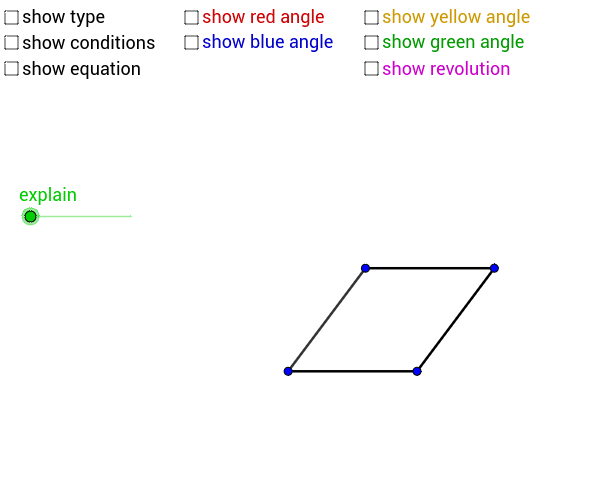
This example demonstrates how to name quadrilaterals and proves that the sum of their interior angles is 360 degrees. Using GeoGebra commands such as Vector, Rotate, Angle, etc., the construction process of quadrilaterals is clearly shown. Suitable for middle school and above students to learn about quadrilateral properties and geometric constructions.
GeoGebra Commands & Parameters
Vector(B, A) → wIf((4 ≤ n) ∧ (n ≤ 5), n - 4, 1) → WIf((2 ≤ n) ∧ (n ≤ 3), n - 2, 1) → SIf((1 ≤ n) ∧ (n ≤ 2), n - 1, 1) → QIf((0 ≤ n) ∧ (n < 1), n, 1) → PIf(P < 1, 0, Q) → RIf(R < 1, 0, S) → TIf((3 ≤ n) ∧ (n ≤ 4), n - 3, 1) → UIf(T < 1, 0, U) → VIf(V < 1, 0, W) → ZRotate(D, (V * 180)°, B) → KVector(D, A) → uLine(A, B) → aLine(C, D) → bLine(A, C) → cLine(B, D) → dAngle(C, A, B) → αLine(D, A) → fLine(E, d) → gLine(E, b) → hAngle(F, E, G) → βVector(C, A) → vRotate(A, (P * 180)°, C) → JRotate(D, (P * 180)°, C) → IRotate(A, (V * 180)°, B) → HAngle(J, L, M) → γAngle(H, O, N) → δPolygon(A, C, D, B) → poly1, a_1, c_1, d_1, b_1OrthogonalLine(C, c_1) → eIntersect(e, a) → E_1OrthogonalLine(E_1, e) → iOrthogonalLine(B, d) → jIntersect(j, c) → F_1OrthogonalLine(F_1, j) → kAngle(C, A, B) → ε