
Quadrilateral Mystery
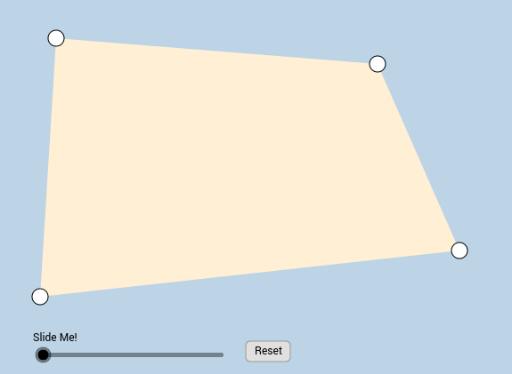
Loading the math board and drawing, please wait…
This example demonstrates an interesting yet uncommon property of quadrilaterals. It involves core geometric concepts such as angles and rotations. Using GeoGebra commands like Polygon, Angle, Rotate, Ray, Intersect, etc., you can dynamically explore the properties of quadrilaterals. Suitable for middle school and above students or teachers to understand geometric transformations and quadrilateral properties.
GeoGebra Commands & Parameters
Polygon(A, B, C, D) → poly1, a, b, c, dAngle(B, A, D) → αAngle(A, D, C) → βAngle(D, C, B) → γAngle(C, B, A) → δRotate(B, α / 2, A) → B'Angle(B, A, B') → εRay(A, B') → fRotate(A, β / 2, D) → A'Angle(A, D, A') → ζRay(D, A') → gRotate(D, γ / 2, C) → D'Angle(D, C, D') → ηRay(C, D') → hRotate(C, δ / 2, B) → C'Angle(C, B, C') → θRay(B, C') → iIntersect(h, i) → FIntersect(f, i) → EIntersect(f, g) → HIntersect(g, h) → GCircle(G, F, E) → eLine(E, G) → jLine(H, F) → kMidpoint(D, C) → IMidpoint(B, C) → JMidpoint(A, B) → KMidpoint(A, D) → LLine(D, C) → lLine(C, B) → mLine(B, A) → nLine(A, D) → pIntersect(p, m) → MIntersect(n, l) → NMin({a, b, c, d}) → oCircle(A, (0.25 * o)) → rCircle(B, (0.25 * o)) → qCircle(D, (0.25 * o)) → sCircle(C, (0.25 * o)) → tIntersect(q, m, 1) → OIntersect(q, i, 1) → PIntersect(r, n, 1) → QIntersect(r, f, 1) → RIntersect(s, p, 1) → SIntersect(s, g, 1) → TIntersect(t, l, 1) → UIntersect(t, h, 1) → VCircleSector(A, Q, R) → c_1CircleSector(C, U, V) → d_1CircleSector(B, O, P) → e_1CircleSector(D, S, T) → f_1Dilate(B, If[0 < u ≤ 1, 1 - u, 0], F) → B'_1Dilate(C, If[0 < u ≤ 1, 1 - u, 0], F) → C'_1Segment(B, B'_1) → g_1Segment(C, C'_1) → h_1Dilate(D, If[1 < u ≤ 2, 2 - u, 0], H) → D'_1Segment(D, D'_1) → i_1Dilate(A, If[1 < u ≤ 2, 2 - u, 0], H) → A'_1Segment(A, A'_1) → j_1Rotate(e_1, If[2 < u ≤ 3, ((u - 2) * θ), θ], B) → k_1Rotate(d_1, If[3 < u ≤ 4, ((u - 3) * η), η], C) → p_1Rotate(f_1, If[4 < u ≤ 5, ((u - 4) * ζ), ζ], D) → q_1Rotate(c_1, If[5 < u ≤ 6, ((u - 5) * ε), ε], A) → r_1Center(e) → WRotate(E, If[7.5 < u ≤ 8.5, (((u - 7.5) * 2) * π), (2 * π)], W) → E'CircleArc(W, E, E') → s_1