
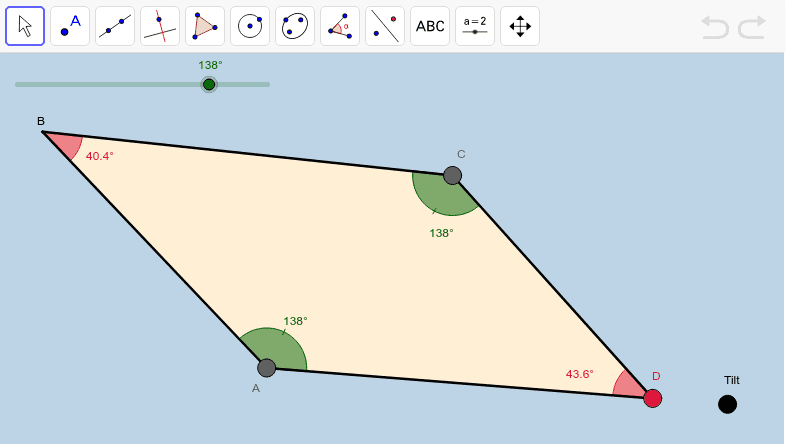
Quadrilateral Investigation: Properties of a Quadrilateral with Congruent Opposi
Loading the math board and drawing, please wait…
In collections
Congruence (CO) Cluster
Congruence (Vol 2)
CCSS High School: Geometry (Congruence) Volume 2
CCSS High School: Geometry (Congruence) Volume 2
CCSS High School: Geometry (Congruence) Volume 2
Geometry (Congruence) Volume 2
CCSS High School: Geometry (Congruence) Volume 2
CCSS High School: Geometry (Congruence) Volume 2
CCSS High School: Geometry (Congruence) Volume 2
CCSS High School: Geometry (Congruence) Volume 2
CCSS High School: Geometry (Congruence) Volume 2
CCSS High School: Geometry (Congruence) Volume 2
CCSS High School: Geometry (Congruence) Volume 2
Gail LeBlancCCSS High School: Geometry (Congruence) Volume 2
CCSS High School: Geometry (Congruence) Volume 2
Quadrilaterals
This example demonstrates the geometric properties of a quadrilateral when it has both pairs of opposite angles congruent. Key math concepts include quadrilaterals, diagonals, parallel lines, and angle relationships. It utilizes GeoGebra commands like Rotate, Angle, Ray, Slope, PointIn, Point, Line, Intersect, Segment, and Polygon to construct and analyze the figure. Suitable for high school students to explore the criteria and properties of parallelograms and special quadrilaterals, enhancing understanding of geometric transformations.
GeoGebra Commands & Parameters
Rotate(A_1, α, A) → A'Angle(A_1, A, A') → βRay(A, A_1) → aRay(A, A') → bSlope(a) → cPointIn(e) → CPoint(a) → DLine(A, C) → fRay(C, D) → hRotate(D, (-α), C) → D'Angle(D', C, D) → γRay(C, D') → iIntersect(b, i) → BAngle(A, B, C) → δAngle(C, D, A) → εSegment(C, D) → jSegment(C, B) → kSegment(B, A) → lSegment(A, D) → mSlope(k) → m_1Slope(l) → m_2Slope(j) → m_3Slope(m) → m_4Polygon(A, D, C, B) → poly1, b_1, d_1, c_1, e_1