
Quadratic Functions Part 3: Vertex Form Transformations and Geometric Integratio
Loading the math board and drawing, please wait…
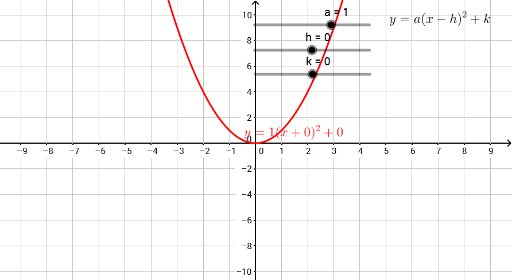
This GeoGebra example demonstrates how the parameters a, h, and k in the vertex form of a quadratic function y=a(x-h)^2+k affect the position and shape of the parabola, while integrating multiple mathematical themes such as geometric transformations, volume, pie charts, pyramids, and conditional probability. The core concepts include quadratic function transformations (translation, scaling, reflection), the significance of the vertex, and connections between functions and geometric figures like pyramid volume and pie chart sectors. Construction highlights: using the If command to create conditional dynamic objects, sliders to control parameters a, h, and k, a list (list1) to store key points, text objects (text1, text2) to display signs and values, and auxiliary points A and c to enable real-time updates of the graph and related geometric quantities as parameters change. Suitable for high school students learning quadratic function properties, transformations, and cross-topic applications, as well as for teachers demonstrating parameter effects and interconnections among mathematical concepts in the classroom.
GeoGebra Commands & Parameters
If(h > 0, "", "+") → PsignIf(k ≥ 0, "+", "") → QsignIf(h > k, (k + 1, 0), (h + 1, 0)) → A