
Quadratic Function Anatomy
Loading the math board and drawing, please wait…
In collections
Quadratic Equation
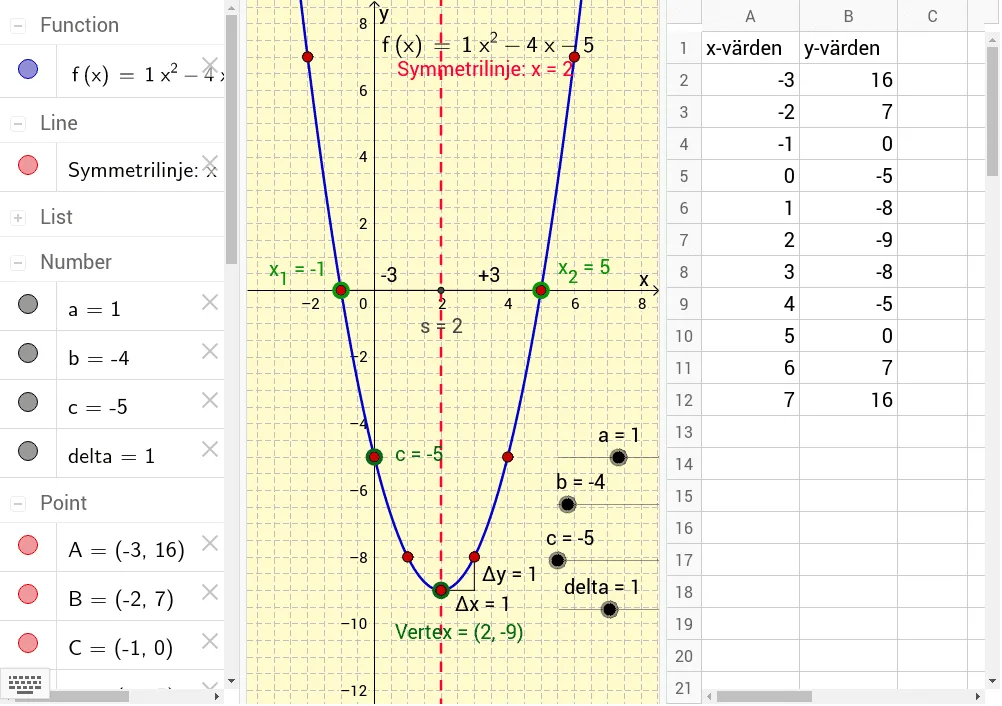
This example demonstrates the dynamic changes in the graph of a quadratic function and its key features (vertex, axis of symmetry, roots). Core math concepts include quadratic functions, vertex, axis of symmetry, roots, derivatives, and integrals. Construction highlights involve GeoGebra commands like Extremum, Root, LaTeX, Intersect, Segment, OrthogonalLine, and objects such as delta, c, b, a, f, Vertex, A1-A12, B1-B12, A-J. Suitable for high school and above students to explore quadratic function properties and calculus applications.
GeoGebra Commands & Parameters
Extremum(f) → VertexRoot(f) → Nollställe_1, Nollställe_2LaTeX(f, true, true) → Text1Intersect(f, x = 0) → c_1Segment(F, L) → ΔxSegment(L, G) → ΔyOrthogonalLine(F, xAxis) → SymmetrilinjeIntersect(Symmetrilinje, xAxis) → MSegment(M, Nollställe_2) → a_1Segment(M, Nollställe_1) → b_1
AI Drawing Prompt Reference
Draw the graph of a quadratic function, dynamically showing its vertex, axis of symmetry, and roots. Label the function expression on the graph, and use line segments to represent the distances from the vertex to the roots. Draw the axis of symmetry, connect the vertex to the roots with line segments, and label the function expression and key points.
The prompt above was compiled from the original drawing commands and is for reference only.