
Jackknife Resampling for Non-linear Data
Loading the math board and drawing, please wait…
In collections
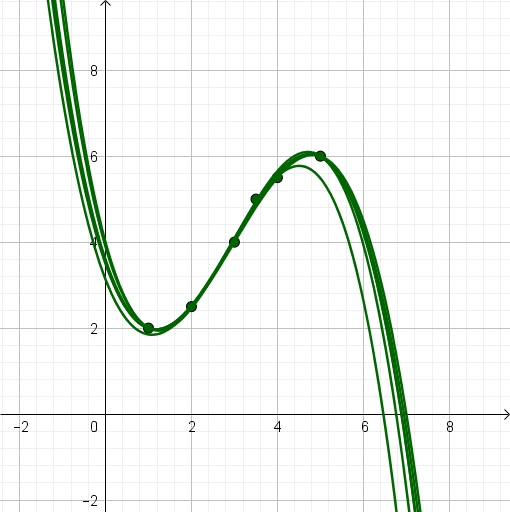
Jackknife resampling to estimate errors in fitted parameters
Jackknife Resampling is a statistical method for analyzing non-linear data by resampling subsets of data. It involves estimating statistics through repeated sampling. Key mathematical concepts include resampling, statistical estimation, and data variability. Construction uses GeoGebra commands like JackknifeResampling with objects d, a, b, c, L, r, l1, l2, m1, m2, l3. Suitable for high school or university math courses to understand non-linear data processing and statistical inference.
GeoGebra Commands & Parameters
JackknifeResampling(a, b, c, d, r, L) → l1, l2, m1, m2, l3
AI Drawing Prompt Reference
Using given data points a, b, c, and d together with resampling parameters r and L, create an illustration of jackknife resampling for non-linear data. Show the procedure as repeated estimation on subsets formed by leaving out parts of the data, where r controls the resampling scheme and L sets the relevant interval/length for the construction. Then generate several key result curves or intermediate estimate outputs that summarize the statistics computed from these resampled subsets, highlighting how the estimated quantities vary with different omitted-data selections. Organize the construction in the same sequence: inputs, jackknife resampling setup, and then the resulting estimate objects.
The prompt above was compiled from the original drawing commands and is for reference only.