
QR4-03-P4a-CYU2 Graphing Quadratics
Loading the math board and drawing, please wait…
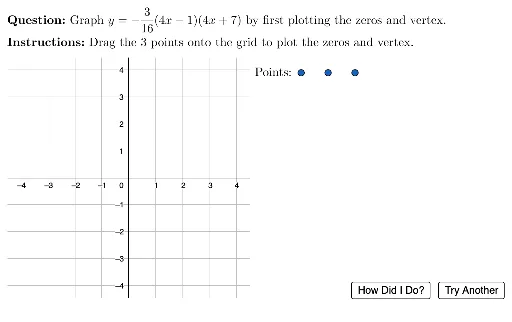
① This interactive example is a graphing quadratics exercise where students plot points on a coordinate plane to construct the graph of a quadratic function, with immediate feedback on correctness. ② Core math concepts include the graph of quadratic functions—vertex, axis of symmetry, direction of opening—and determining key coordinates, while also incorporating probability and conditional probability in the feedback system (random problem generation, attempt counting). ③ Construction highlights: from the summary, GeoGebra commands such as Element, Flatten, Sequence, Point, UnicodeToLetter, LaTeX, and FitPoly are used; objects include userPts, correctPts, fbPoint, GridSpace, PointSpace, P1/P2/P3, and interactive controls like isCorrect, showFeedback, TryAnother, with visual markers xmark and cmark. ④ Suitable for middle or high school students learning quadratic functions, and useful for classroom demonstration or self-paced practice to reinforce the relationship between quadratic equations and their graphs.
GeoGebra Commands & Parameters
Element(SolutionPtsLst, caseIndx) → correctPtsFlatten(Sequence[Sequence[(i, j), i, -4, 4, 0.25], j, -4, 4, 0.25]) → GridSpaceSequence((i, y(fbPoint + 1.7)), i, x(fbPoint) + 2, x(fbPoint) + 4, 1) → PointSpacePoint(Union[GridSpace, {Element[PointSpace, 1]}]) → P1Point(Union[GridSpace, {Element[PointSpace, 2]}]) → P2Point(Union[GridSpace, {Element[PointSpace, 3]}]) → P3UnicodeToLetter(10007) → xmarkUnicodeToLetter(10003) → cmarkLaTeX("\text{Points:}") → txtPointLblLaTeX(chkUserInput) → fbCorrectLaTeX("\text{Plot all three points before \\checking your work.}") → fbNotDoneLaTeX("\text{The three points you should plot are the \\two zeros and the vertex. Please try again.}") → fbTryAgainPoint(GridSpace) → B2Point(GridSpace) → B3Point(GridSpace) → C2Point(GridSpace) → C3Point(GridSpace) → D2FitPoly(B2:B4, 2) → B5FitPoly(C2:C4, 2) → C5Point(GridSpace) → D3FitPoly(D2:D4, 2) → D5Point(GridSpace) → E2Point(GridSpace) → E3FitPoly(E2:E4, 2) → E5LaTeX("\Big(1,\dfrac{7}{4}\Big)") → B9Element(FunctionLst, caseIndx) → correctFuncElement(FunctionLst, caseIndx) → hintFuncElement(LatexValsLst, caseIndx) → CaseLatexValsLaTeX((("{\text{The vertex is } " * Element[CaseLatexVals, 2]) * ".")) → fbVertexLaTeX("x=1") → B12LaTeX("x=-1") → C12LaTeX("x=\dfrac{1}{4}") → E12LaTeX((("\text{The equation of the axis of symmetry is }" * Element[CaseLatexVals, 5]) * ".")) → fbAxisSymLaTeX("\Big(-1,-\dfrac{ 5}{4}\Big)") → C9LaTeX("\Big(-\dfrac{3}{4},3\Big)") → D9LaTeX("\Big(\dfrac{1}{4},-\dfrac{15}{4}\Big)") → E9LaTeX(If[A15 < 0, "-", ""]) → A21LaTeX(If[A15 ≟ 0, "0", If[A16 ≟ 0, "", ("" * A16)]]) → A22LaTeX(If[A17 ≟ 0, "", (((("\dfrac{" * A19) * "}{") * A20) * "}")]) → A23LaTeX(((("" * A21) * A22) * A23)) → A24LaTeX(If[B15 < 0, "-", ""]) → B21LaTeX(If[B15 ≟ 0, "0", If[B16 ≟ 0, "", ("" * B16)]]) → B22LaTeX(If[B17 ≟ 0, "", (((("\dfrac{" * B19) * "}{") * B20) * "}")]) → B23LaTeX(((("" * B21) * B22) * B23)) → B24LaTeX((((("\big(" * A24) * ",") * B24) * "\big)")) → lblActivePtLaTeX("x=-\dfrac{3}{4}") → D12LaTeX("x=-\dfrac{ 1}{2}") → B10LaTeX("x=-\dfrac{5}{2}") → C10LaTeX("x=-\dfrac{7}{4}") → D10LaTeX("x=-\dfrac{7}{2}") → E10LaTeX("x=\dfrac{5}{2}") → B11LaTeX("x-\dfrac{1}{2}") → C11LaTeX("x=\dfrac{1}{4}") → D11LaTeX("x=4") → E11LaTeX(((((" \text{The zeros occur at \(" * Element[CaseLatexVals, 3]) * "\) and \( ") * Element[CaseLatexVals, 4]) * "\).")) → fbZerosLaTeX((((("\text{\textbf{Question: }" * MainInstruc) * "\\\textbf{Instructions: }") * SpecInstruc) * "}")) → allInstruc