
Pythagorean Theorem with Regular Polygons
Loading the math board and drawing, please wait…
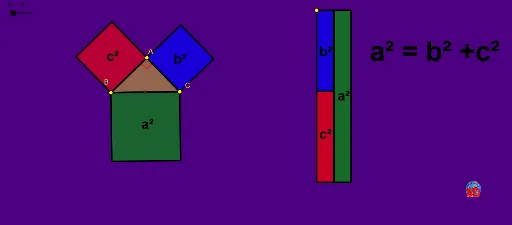
This example demonstrates the application of the Pythagorean theorem in regular polygons. Key mathematical concepts include the Pythagorean theorem and polygons. Using GeoGebra commands such as Circle, Point, Mirror, Midpoint, and Polygon, the construction of regular polygons and their properties are illustrated. Suitable for middle school and above students to learn geometry and trigonometry.
GeoGebra Commands & Parameters
Circle(G_2, 12 / sqrt(n)) → c_2Point(c_2) → BMirror(B, G_2) → CMidpoint(C, B) → C_1Circle(C_1, Distance[C, B] / 2) → c_1Point(c_2) → APolygon(A, C, n) → poly3, i, e_1, h_2, j_2, m_2, q_2, E, H, K, N, R, j, E_1, H_1, K_1, N_1, P_1, S_1, V_1, k, r, d, g_1, j_1, m_1, r_1Polygon(A, B, C) → poly1, c, a, bPolygon(B, A, n) → poly2, f, d_1, g_2, k_2, n_2, r_2, D, G, J, M, Q, g, D_1, G_1, J_1, M_1, Q_1, T_1, W_1, h, q, t, f_1, i_1, l_1, q_1Polygon(C, B, n) → poly4, l, f_2, i_2, l_2, p_2, s_2, F, I, L, O, S, m, F_1, I_1, L_1, O_1, R_1, U_1, Z_1, p, s, e, h_1, k_1, n_1, s_1Polygon(P, T, V, U) → q1, p_1, t_1, v, uPolygon(U, V, Z, W) → q2, u_1, v_1, z_1, wPolygon(T, A_1, B_1, Z) → q3, t_2, a_1, b_1, z_2Centroid(poly2) → A_2Centroid(poly3) → B_2Centroid(poly4) → C_2Centroid(q1) → D_2Centroid(q2) → E_2Centroid(q3) → F_2Angle(B, A, C) → α
AI Drawing Prompt Reference
Draw a regular polygon and illustrate its geometric construction using the Pythagorean theorem. Start by drawing a circle, then take a point on the circle and find its symmetric point with respect to the center. Locate the midpoint between these two points and draw a new circle centered at this midpoint. Take a point on the new circle, connect it to the center, and construct three regular polygons based on this setup to demonstrate the relationship between the polygons and the Pythagorean theorem.
The prompt above was compiled from the original drawing commands and is for reference only.