
Pythagorean Theorem Proof Based on Similarity
Loading the math board and drawing, please wait…
In collections
Pythagorean Theorem
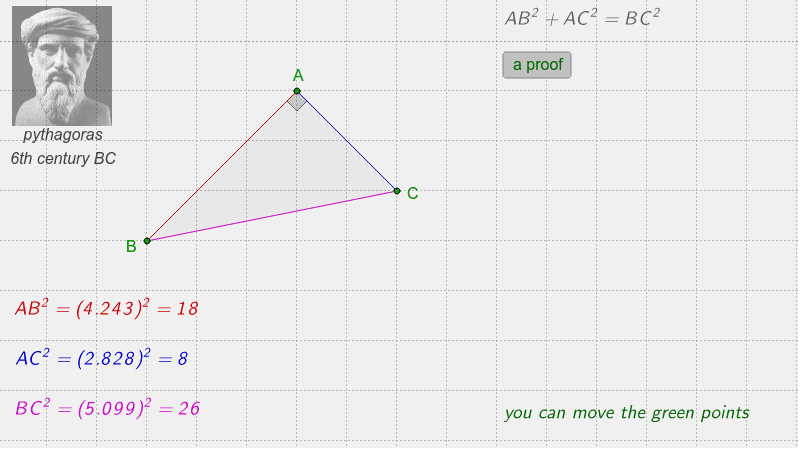
This example demonstrates the Pythagorean theorem based on similarity. Using GeoGebra commands such as Segment, OrthogonalLine, and Rotate, it constructs the relationship between the sides of a triangle to illustrate the core concept of the theorem. Suitable for middle school and above students to learn geometric proofs.
GeoGebra Commands & Parameters
Segment(A, B) → aOrthogonalLine(A, a) → bPoint(b) → CSegment(C, B) → cSegment(A, C) → dRotate(C, 90*°, A) → C'OrthogonalLine(A, c) → eIntersect(e, c) → DAngle(C, D, A) → βAngle(C, B, A) → γSegment(A, D) → fAngle(A, C, D) → ζAngle(B, A, C) → αAngle(B, A, D) → δAngle(D, A, C) → εPolygon(B, A, C) → poly1, c_1, b_1, a_1
AI Drawing Prompt Reference
Draw a right triangle ABC with AB as the hypotenuse and BC and AC as the legs. Construct a perpendicular line from point C to AB, intersecting at point D. Then rotate point C to get point C', and draw angles β, γ, ζ, α, δ, and ε. Finally, draw quadrilateral BADC.
The prompt above was compiled from the original drawing commands and is for reference only.