
Eratosthenes Sieve Demonstration
Loading the math board and drawing, please wait…
In collections
Arithmetic Operations (preGED)
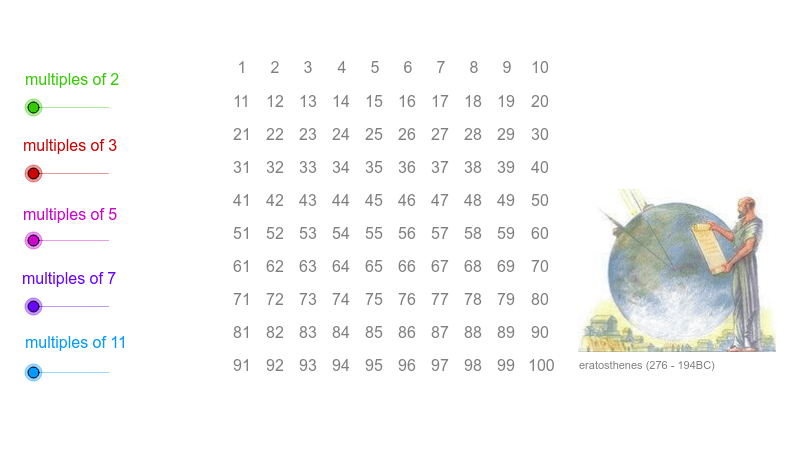
This example visually demonstrates the Sieve of Eratosthenes, showing the step-by-step process of identifying prime numbers through dynamic interaction; Core math concepts include prime number determination, sequences, logical reasoning, and geometric visualization; GeoGebra commands and objects used in construction are Segment, Point, Polygon, Corner, Sequence, Circle; Suitable for middle school and above students to understand prime number distribution and algorithmic visualization.
GeoGebra Commands & Parameters
Segment((1, -4), (a, -4)) → bPoint(b) → APolygon((0, -4), A, (x(A), y(B)), B) → polígono1, c, d, g, hCorner(1) → CPolygon((0, -4), A, (x(A), y(B)), B) → poligono2, e, f, i, jSequence(Sequence[If[(Mod[10 * s + t, 2] ≠ 0) ∧ (Mod[10 * s + t, 3] ≠ 0) ∧ (Mod[10 * s + t, 5] ≠ 0) ∧ (Mod[10 * s + t, 7] ≠ 0) ∧ (Mod[10 * s + t, 11] ≠ 0), Circle[(t + 0.2, 5 - s + 0.15), 0.3], Text["", (t, 5 - s)]], t, 1, 10], s, 1, 9) → L21Sequence(If[t ≟ 2 ∨ t ≟ 3 ∨ t ≟ 5 ∨ t ≟ 7, Circle[(t + 0.2, 5.15), 0.3], Text["", (t, 5)]], t, 2, 10) → L22Circle((1.2, 4.15), 0.3) → qSequence(Circle[Element[L31, t], 0.3], t, 1, 15) → L32Sequence(If[Mod[a, t] ≟ 0, Circle[(t - 0.8, 5.15), 0.3], ""], t, 1, a) → lista1Sequence(Text[If[t < 10, " " + (t) + " ", "" + (t)], (t - 1, 5)], t, 1, 15) → texto7Sequence(Sequence[If[s ≟ 0 ∧ (t < 10), Text[" " + (t) + " ", (t + 0.05, 5.05 - s)], If[s ≟ 9 ∧ t ≟ 10, Text["100", (t - 0.06, 5.05 - s)], Text[10 * s + t, (t + 0.03, 5.05 - s)]]], t, 1, 10], s, 0, 9) → L01Sequence(Sequence[If[Mod[10 * s + t, 2] ≟ 0 ∧ (10 * s + t ≠ 2), Circle[(t + 0.3, 5 - s + 0.3), 0.4], Text["", (t, 5 - s)]], t, 1, 10], s, 0, p - 1) → L02Sequence(Sequence[If[Mod[10 * s + t, 3] ≟ 0 ∧ (10 * s + t ≠ 3), Circle[(t + 0.3, 5 - s + 0.3), 0.4], Text["", (t, 5 - s)]], t, 1, 10], s, 0, t_1 - 1) → L03Sequence(Sequence[If[Mod[10 * s + t, 5] ≟ 0 ∧ (10 * s + t ≠ 5), Circle[(t + 0.3, 5 - s + 0.3), 0.4], Text["", (t, 5 - s)]], t, 1, 10], s, 0, t_2 - 1) → L05Sequence(Sequence[If[Mod[10 * s + t, 7] ≟ 0 ∧ (10 * s + t ≠ 7), Circle[(t + 0.3, 5 - s + 0.3), 0.4], Text["", (t, 5 - s)]], t, 1, 10], s, 0, t_3 - 1) → L07Sequence(Sequence[If[Mod[10 * s + t, 11] ≟ 0 ∧ (10 * s + t ≠ 11), Circle[(t + 0.3, 5 - s + 0.3), 0.4], Text["", (t, 5 - s)]], t, 1, 10], s, 0, t_4 - 1) → L11
AI Drawing Prompt Reference
Create a dynamic visualization of the Sieve of Eratosthenes, showing the step-by-step identification of prime numbers. Include a horizontal segment and several points forming a polygon. Use circles of varying sizes to represent prime and composite numbers, with their positions and sizes dynamically changing based on the primality of the numbers. Label the numbers 1 to 100 below the main graphic, marking composite numbers with circles. The layout should be clear with distinct colors to easily understand the distribution and filtering process of prime numbers.
The prompt above was compiled from the original drawing commands and is for reference only.