
Pythagorean Theorem Geometric Construction by cemccourseware
Loading the math board and drawing, please wait…
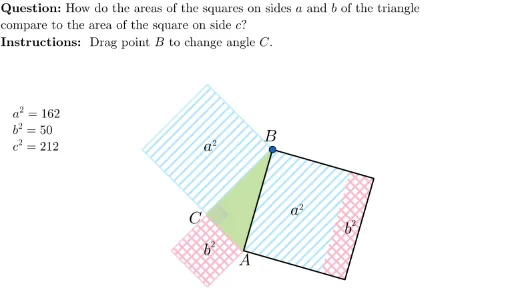
This example demonstrates the Pythagorean Theorem by constructing the relationship between the sides of a right triangle, showing that the square of the hypotenuse is equal to the sum of the squares of the other two sides. Key mathematical concepts include right triangles, the Pythagorean Theorem, and vectors. It uses commands like Polygon, PointIn, DynamicCoordinates, etc., in GeoGebra. Suitable for middle school and above students to learn geometric construction.
GeoGebra Commands & Parameters
Polygon(K, L, N, C + (0, 3)) → q1, b, e, f_1, g_1PointIn(q1) → KKDynamicCoordinates(KK, x(KK), If[Distance[KK, x = y] < 0.2, x(KK), y(KK)]) → AIntersect(xAxis, yAxis) → BPolygon(A, B, C) → t1, s, t, aPolygon(B, A, 4) → poly1, f, g, h, i, E, FPolygon(C, B, 4) → poly2, j, k, l, m, G, HPolygon(A, C, 4) → poly3, n, p, q, r, I, JUnitVector(Segment[A, J]) → uPolygon(A, A_1, C_1, C) → area1, a_1, a_2, c_1, cPolygon(A_1, A_2, C_2, C_1) → area2, a_3, a_4, c_2, c_3Angle(C, B, A) → αLaTeX("\text{\textbf{Question: }How do the areas of the squares on sides \(a\) and \(b\) of the triangle \\compare to the area of the square on side \(c\)?}") → MainInstruc
AI Drawing Prompt Reference
A right triangle with its right angle at the origin has squares built outward on each side; the large square on the hypotenuse is split into two adjacent quadrilaterals to illustrate that the sum of the areas of the two leg squares equals the area of the hypotenuse square; the right angle is marked, a unit vector lies along one edge of the hypotenuse square, and one vertex can slide near the line y = x to vary the triangle’s shape.
The prompt above was compiled from the original drawing commands and is for reference only.