
Pythagorean Theorem Demo: Right Triangle Square Sum
Loading the math board and drawing, please wait…
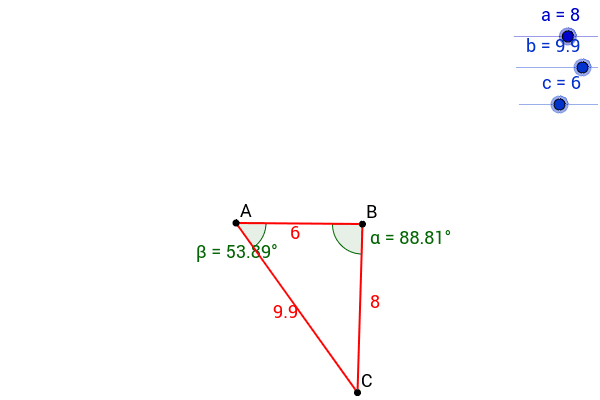
① This example demonstrates the Pythagorean theorem, showing that in a right triangle the sum of the squares of the legs equals the square of the hypotenuse. ② Core math concepts: Pythagorean theorem, right triangles, square relationships, similarity transformations and rotations. ③ Construction highlights: GeoGebra commands Point, Segment, Circle, Intersect, Angle are used to create points A, B, C, D, segments a, b, c, circle c, and angles α, β. ④ Suitable for middle‑school geometry (grades 7‑9) and high‑school review, also useful as a geometric construction exercise.
GeoGebra Commands & Parameters
Point(Circle[A, c]) → BSegment(A, B) → b_1Circle(B, a) → dCircle(A, b) → eIntersect(d, e) → C, D, ,Segment(A, C) → fSegment(C, B) → gAngle(A, B, C) → αAngle(C, A, B) → β
AI Drawing Prompt Reference
Draw a right triangle with points A and B as the endpoints of the two legs and point C as the endpoint of the hypotenuse. Create segment AB using points A and B, then draw a circle with center B and radius AB, and another circle with center A and radius AB. The intersection of these two circles (other than point A) is point C. Connect points A and C, and then connect points C and B to form right triangle ABC. Measure angles A and B to demonstrate the Pythagorean theorem: the sum of the squares of the lengths of the two legs equals the square of the length of the hypotenuse.
The prompt above was compiled from the original drawing commands and is for reference only.