
Pythagorean Theorem: Building Right Triangles
Loading the math board and drawing, please wait…
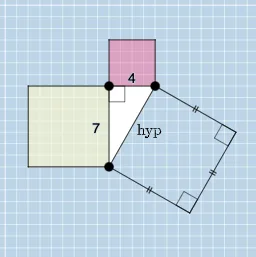
This example demonstrates creating distances on a grid by constructing right triangles to verify the Pythagorean theorem. Core math concepts include the Pythagorean theorem, right triangles, distance calculation, and coordinate systems. It uses commands/objects like Point, Segment, Ray, Distance, Polygon, Midpoint, Dilate, Vector, Translate, Line, OrthogonalLine, Intersect, Angle, RandomElement in GeoGebra. Suitable for middle school and above mathematics education, ideal for quick formative assessment and basic feedback.
GeoGebra Commands & Parameters
Point(Ray[C, Q]) → ASegment(C, A) → t_2Ray(O, P) → d_2Point(d_2) → BDistance(A, B) → aPolygon(A, C, 4) → poly1, f, g, h, i, D, EPolygon(C, B, 4) → poly2, j, k, l, m, F, GPolygon(B, A, 4) → poly3, n, p, q, r, H, IMidpoint(C, F) → JMidpoint(E, C) → KDilate(K, If[0 < t3 ≤ 1, 1 - t3, 0], J) → K'Vector(K, K') → uTranslate(poly1, u) → poly1'Midpoint(A, I) → LLine(D, C) → sVector(K, J) → vSegment(C, G) → tSegment(G, F) → cSegment(F, B) → dSegment(B, C) → eLine(D, E) → f_1Line(E, A) → g_1Line(A, C) → h_1OrthogonalLine(L, e) → i_1OrthogonalLine(L, i_1) → j_1Line(H, I) → k_1Line(I, B) → l_1Line(B, A) → m_1Line(A, H) → n_1Intersect(j_1, n_1) → MIntersect(i_1, k_1) → NIntersect(j_1, l_1) → RIntersect(i_1, m_1) → SPolygon(M, L, N, H) → q1, m_2, l_2, n_2, h_2Polygon(A, S, L, M) → q2, a_1, s_1, l_3, m_3Polygon(S, B, R, L) → q3, s_2, b_1, r_1, l_4Polygon(N, I, R, L) → q4, n_3, i_2, r_2, l_5Vector(L, C) → wVector(L, G) → u_1Vector(L, F) → v_1Vector(L, B) → w_1Translate(M, v_1) → M'Translate(L, v_1) → L'Translate(N, v_1) → N'Translate(H, v_1) → H'Polygon(M', L', N', H') → q1', m', l', n', h'Translate(N, u_1) → N'_1Translate(I, u_1) → I'Translate(R, u_1) → R'Translate(L, u_1) → L'_1Polygon(N'_1, I', R', L'_1) → q4', n'_1, i', r', l'_1Translate(S, w) → S'Translate(B, w) → B'Translate(R, w) → R'_1Translate(L, w) → L'_2Polygon(S', B', R'_1, L'_2) → q3', s', b', r'_1, l'_2Translate(A, w_1) → A'Translate(S, w_1) → S'_1Translate(L, w_1) → L'_3Translate(M, w_1) → M'_1Polygon(A', S'_1, L'_3, M'_1) → q2', a', s'_1, l'_3, m'_1Dilate(L, If[1 < t3 ≤ 2, 2 - t3, 0], F) → L'_4Vector(L, L'_4) → d_1Vector(L, L'_4) → e_1Translate(M, e_1) → M'_2Translate(L, e_1) → L'_5Translate(N, e_1) → N'_2Translate(H, e_1) → H'_1Polygon(M'_2, L'_5, N'_2, H'_1) → q1'_1, m'_2, l'_5, n'_2, h'_1Dilate(L, If[2 < t3 ≤ 3, 3 - t3, 0], B) → L'_6Vector(L, L'_6) → c_1Translate(A, c_1) → A'_1Translate(S, c_1) → S'_2Translate(L, c_1) → L'_7Translate(M, c_1) → M'_3Polygon(A'_1, S'_2, L'_7, M'_3) → q2'_1, a'_1, s'_2, l'_7, m'_3Dilate(L, If[3 < t3 ≤ 4, 4 - t3, 0], C) → L'_8Vector(L, L'_8) → p_1Translate(S, p_1) → S'_3Translate(B, p_1) → B'_1Translate(R, p_1) → R'_2Translate(L, p_1) → L'_9Polygon(S'_3, B'_1, R'_2, L'_9) → q3'_1, s'_3, b'_1, r'_2, l'_9Dilate(L, If[4 < t3 ≤ 5, 5 - t3, 0], G) → L'_{10}Vector(L, L'_{10}) → q_1Translate(N, q_1) → N'_3Translate(I, q_1) → I'_1Translate(R, q_1) → R'_3Translate(L, q_1) → L'_{11}Polygon(N'_3, I'_1, R'_3, L'_{11}) → q4'_1, n'_3, i'_1, r'_3, l'_{11}Segment(C, D) → t_1Segment(D, E) → f_2Segment(E, A) → g_2Segment(A, H) → j_2Segment(H, I) → k_2Segment(I, B) → p_2Segment(B, A) → q_2Angle(B, A, C) → αPolygon(C, A, B) → t1_1, b_2, c_2, a_2Angle(C, G, F) → βAngle(G, F, B) → γRandomElement(l1) → o, 8
AI Drawing Prompt Reference
On a grid, construct a right triangle and measure the lengths of its three sides. Then, draw three polygons using these side lengths and find their centroids. Next, draw auxiliary lines through the centroids and vertices, and create perpendicular lines. Finally, use these line segments and polygons to construct four new polygons, demonstrating the geometric proof that the square of the hypotenuse equals the sum of the squares of the other two sides in a right triangle.
The prompt above was compiled from the original drawing commands and is for reference only.