
Pythagorean Theorem Algebraic Proof
Loading the math board and drawing, please wait…
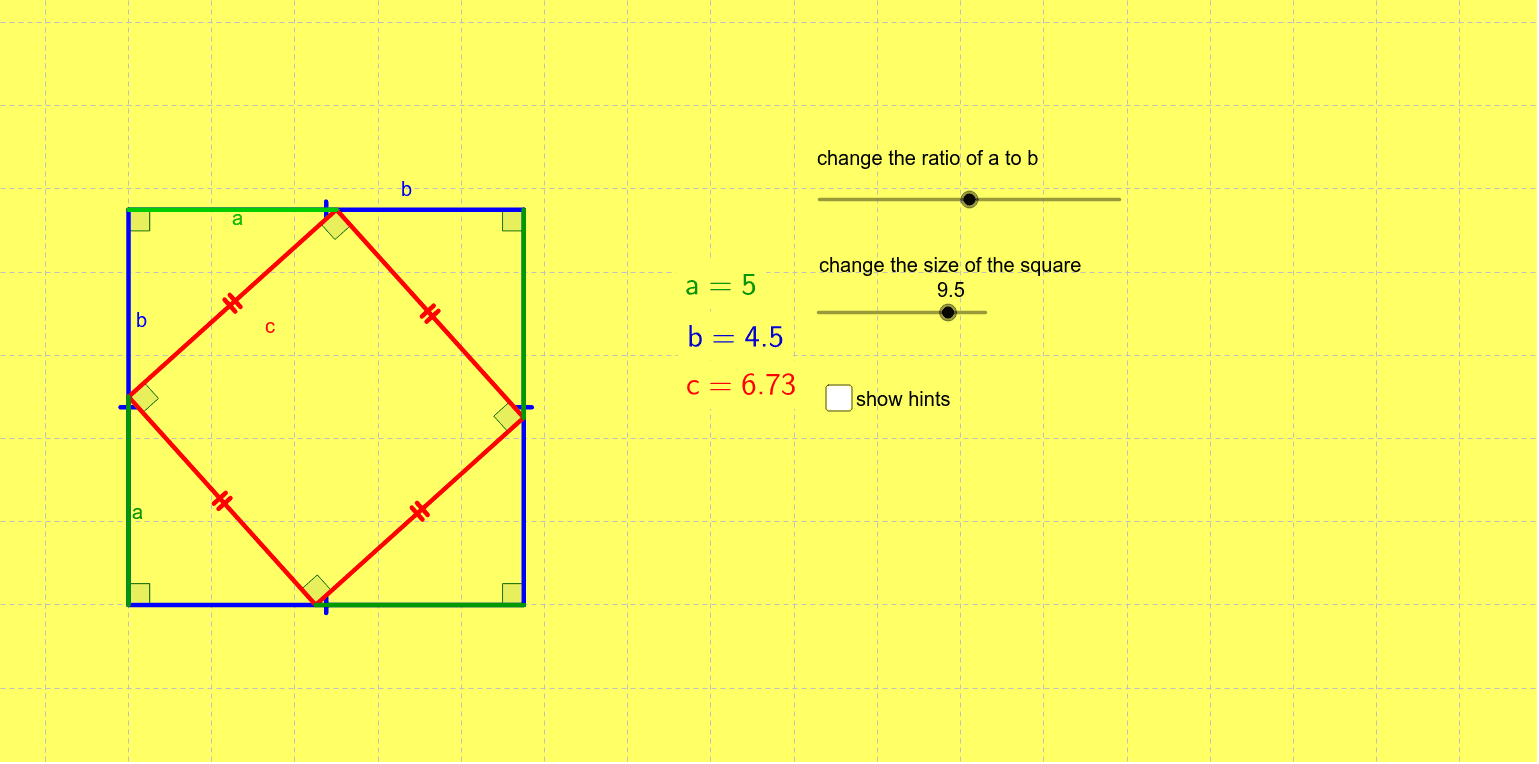
This example demonstrates the algebraic proof of the Pythagorean Theorem. It involves core mathematical concepts such as the Pythagorean Theorem, Tree Diagrams, Rational Numbers, Histograms, Tangent Function, and Polygons. The construction uses GeoGebra commands like Intersect, Segment, Distance, and Angle. It is suitable for high school students learning and understanding the algebraic proof of the Pythagorean Theorem.
GeoGebra Commands & Parameters
Intersect(xAxis, yAxis) → ASegment(B, C) → bSegment(C, D) → b_1Segment(D, A) → cSegment(A, B) → dSegment(L, K) → eSegment(K, I) → fSegment(I, E) → gSegment(E, L) → hDistance(B, K) → distanceBKDistance(K, C) → distanceKCIntersect(b, d) → FIntersect(b, e) → GSegment(F, G) → jIntersect(c, d) → HIntersect(d, e) → JSegment(H, J) → kDistance(H, J) → distanceHJIntersect(c, g) → NSegment(M, N) → lIntersect(b, b_1) → OIntersect(b_1, f) → PSegment(O, P) → mDistance(J, F) → distanceJFDistance(O, P) → distanceOPDistance(H, N) → distanceHNDistance(M, N) → distanceMNDistance(P, M) → distancePMDistance(J, G) → distanceJGDistance(G, P) → distanceGPDistance(P, N) → distancePNDistance(N, J) → distanceNJAngle(A, B, C) → γAngle(B, C, D) → δAngle(L, K, I) → εAngle(I, E, L) → ζAngle(E, L, K) → ηAngle(K, I, E) → θAngle(D, A, B) → ιAngle(C, D, A) → κ