
Pythagoras Theorem Proof
Loading the math board and drawing, please wait…
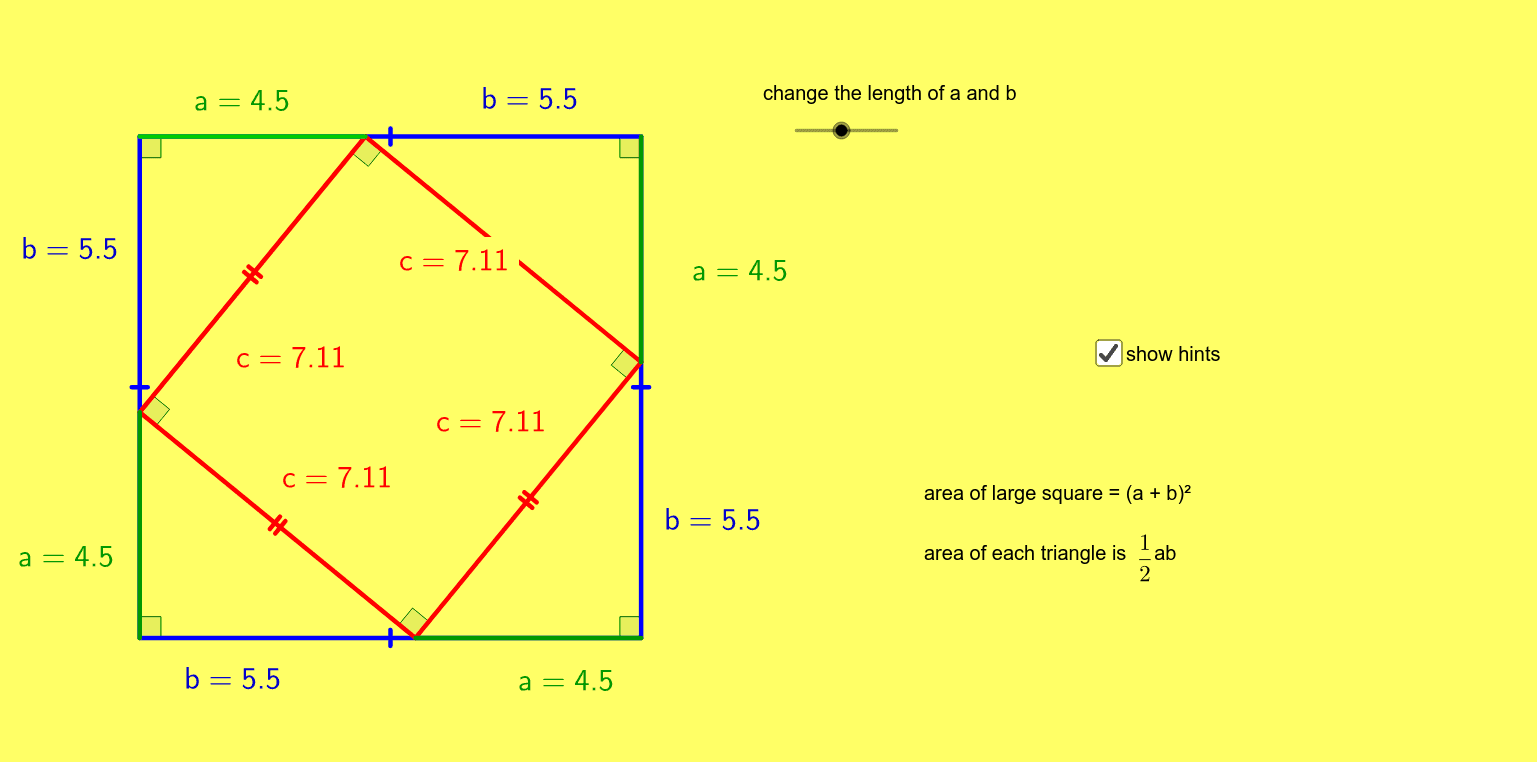
This example demonstrates a geometric proof of the Pythagorean Theorem. It involves the relationship between the sides of a right triangle. Using commands like Intersect, Point, Segment, Distance, etc., from the construction summary, it shows how to verify the theorem through geometric transformations. Suitable for middle school and above students to learn geometric proof methods.
GeoGebra Commands & Parameters
Intersect(xAxis, yAxis) → APoint(yAxis) → BPoint(xAxis) → DSegment(B, C) → aSegment(C, D) → bSegment(D, A) → cSegment(A, B) → dSegment(L, K) → eSegment(K, I) → fSegment(I, E) → gSegment(E, L) → hDistance(B, K) → distanceBKDistance(K, C) → distanceKCIntersect(a, d) → FIntersect(a, e) → GSegment(F, G) → jIntersect(c, d) → HIntersect(d, e) → JSegment(H, J) → kDistance(H, J) → distanceHJIntersect(b, c) → MIntersect(c, g) → NSegment(M, N) → lIntersect(a, b) → OIntersect(b, f) → PSegment(O, P) → mDistance(J, F) → distanceJFDistance(O, P) → distanceOPDistance(H, N) → distanceHNDistance(M, N) → distanceMNDistance(P, M) → distancePMDistance(J, G) → distanceJGDistance(G, P) → distanceGPDistance(P, N) → distancePNDistance(N, J) → distanceNJAngle(A, B, C) → γAngle(B, C, D) → δAngle(L, K, I) → εAngle(I, E, L) → ζAngle(E, L, K) → ηAngle(K, I, E) → θAngle(D, A, B) → ιAngle(C, D, A) → κ
AI Drawing Prompt Reference
Draw a right triangle ABC with point A on the x-axis, point B on the y-axis, and point C in the first quadrant. Then draw sides AB, BC, and CA with their lengths. Next, draw the perpendicular bisector of AB, which intersects BC at F and AC at G, and draw FG. Repeat this process for other sides, find their intersections, and verify the Pythagorean theorem.
The prompt above was compiled from the original drawing commands and is for reference only.