
Pythagorean Square Pyramid
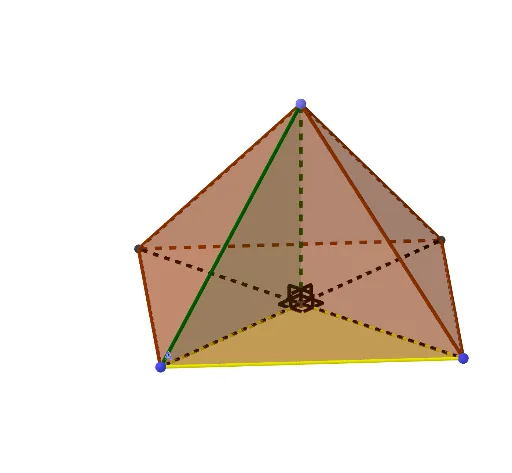
Loading the math board and drawing, please wait…
This example demonstrates a geometric model of a square-based pyramid constructed based on the Pythagorean theorem. It involves core mathematical concepts such as solid geometry, the Pythagorean theorem, polygon area, and angle calculations. The construction uses GeoGebra commands/objects like Line, OrthogonalLine, Circle, Point, Plane, Intersect, Segment, Pyramid, Angle, and Polygon. Suitable for high school mathematics teaching or exploration by geometry enthusiasts.
GeoGebra Commands & Parameters
Line(A, B) → fOrthogonalLine(B, xOyPlane) → gCircle(g, A) → cOrthogonalLine(A, xOyPlane) → iPoint(g) → CPlane(A, B, C) → bOrthogonalLine(A, b) → hOrthogonalLine(B, b) → jCircle(i, B) → dIntersect(h, d) → D, EIntersect(j, c) → F, GSegment(B, E) → kSegment(A, G) → lIntersect(l, k) → HOrthogonalLine(H, xOyPlane) → mPoint(m) → IPyramid(B, G, E, A, I) → a, faceABGE, edgeBI, edgeGI, edgeEI, edgeAI, faceBGI, faceEGI, faceAEI, faceABI, edgeBG, edgeEG, edgeAE, edgeABSegment(H, I) → nAngle(A, H, B) → αAngle(I, H, B) → βAngle(A, H, E) → γAngle(G, H, E) → δAngle(B, H, G) → εAngle(I, H, A) → ζAngle(I, H, G) → ηAngle(I, H, E) → θPolygon(I, H, A) → t1, a_1, i_1, h_1Polygon(A, H, B) → t2, b_1, a_2, h_2