
ASA (Angle-Side-Angle) Congruence Case 2
Loading the math board and drawing, please wait…
In collections
Congruent Triangles
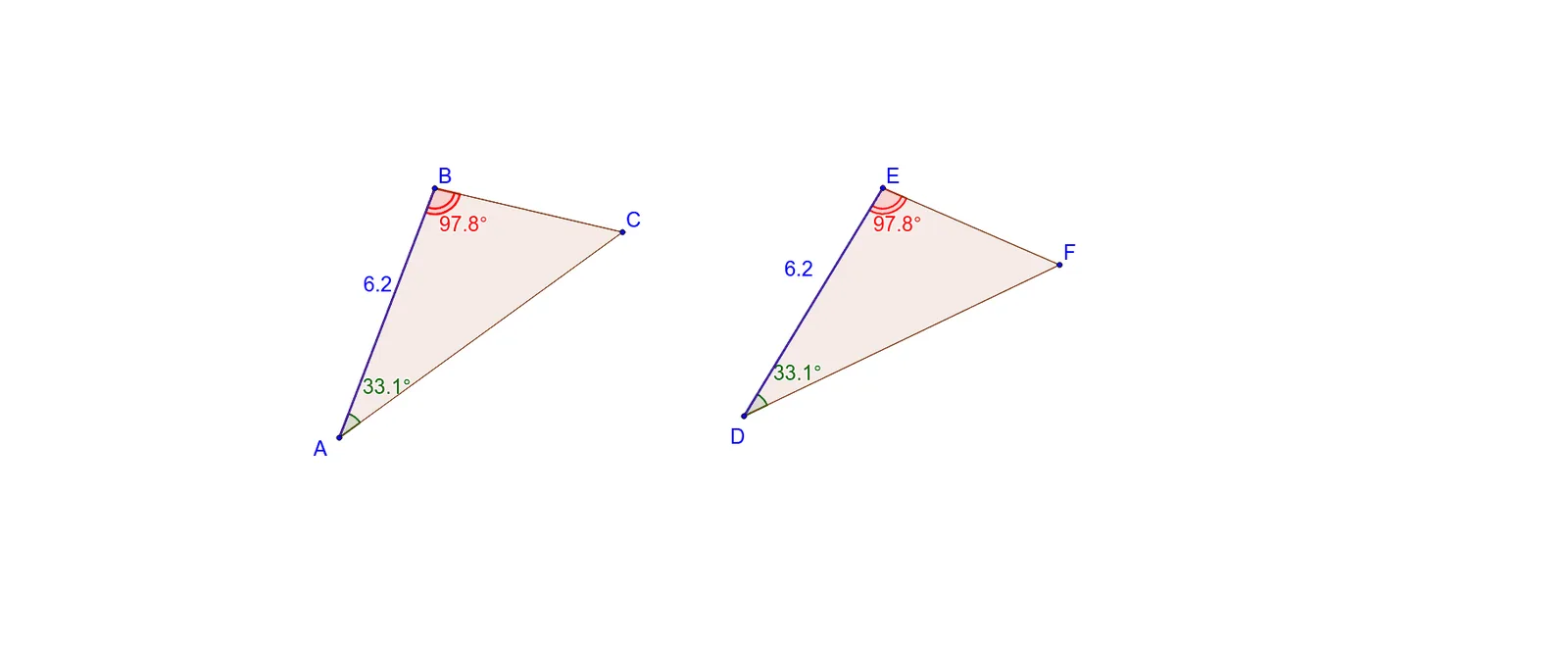
This example demonstrates how to construct a unique triangle given two angles and the included side (ASA condition), and verifies the congruence of two triangles built under the same conditions. The core mathematical concept is the ASA (Angle-Side-Angle) triangle congruence criterion, which states that if two angles and the included side of one triangle are respectively equal to those of another, the triangles are congruent. The construction uses GeoGebra commands including Segment, Circle, Angle, Point, Rotate, Line, Intersect, and Polygon. The process involves drawing the given side, constructing the two adjacent angles using circles and rotations, finding the third vertex via intersections, and finally forming polygons to compare corresponding sides and angles. This is suitable for middle school geometry lessons or high school review of congruence theorems, providing an interactive visual proof of the ASA criterion and its construction method.
GeoGebra Commands & Parameters
Segment(A, B) → aCircle(A, B) → cSegment(A, C) → bSegment(C, B) → dAngle(C, A, B) → αAngle(A, B, C) → βCircle(D, a) → ePoint(e) → ESegment(D, E) → fRotate(E, (-α), D) → E'Angle(E', D, E) → γLine(D, E') → gRotate(D, β, E) → D'Angle(D, E, D') → δLine(E, D') → hIntersect(g, h) → FLine(D, F) → iSegment(E, F) → jSegment(D, F) → kPolygon(A, B, C) → poly1, c_1, a_1, b_1Polygon(D, E, F) → poly2, f_1, d_1, e_1