
Pythagoras Theorem with Semicircles
Loading the math board and drawing, please wait…
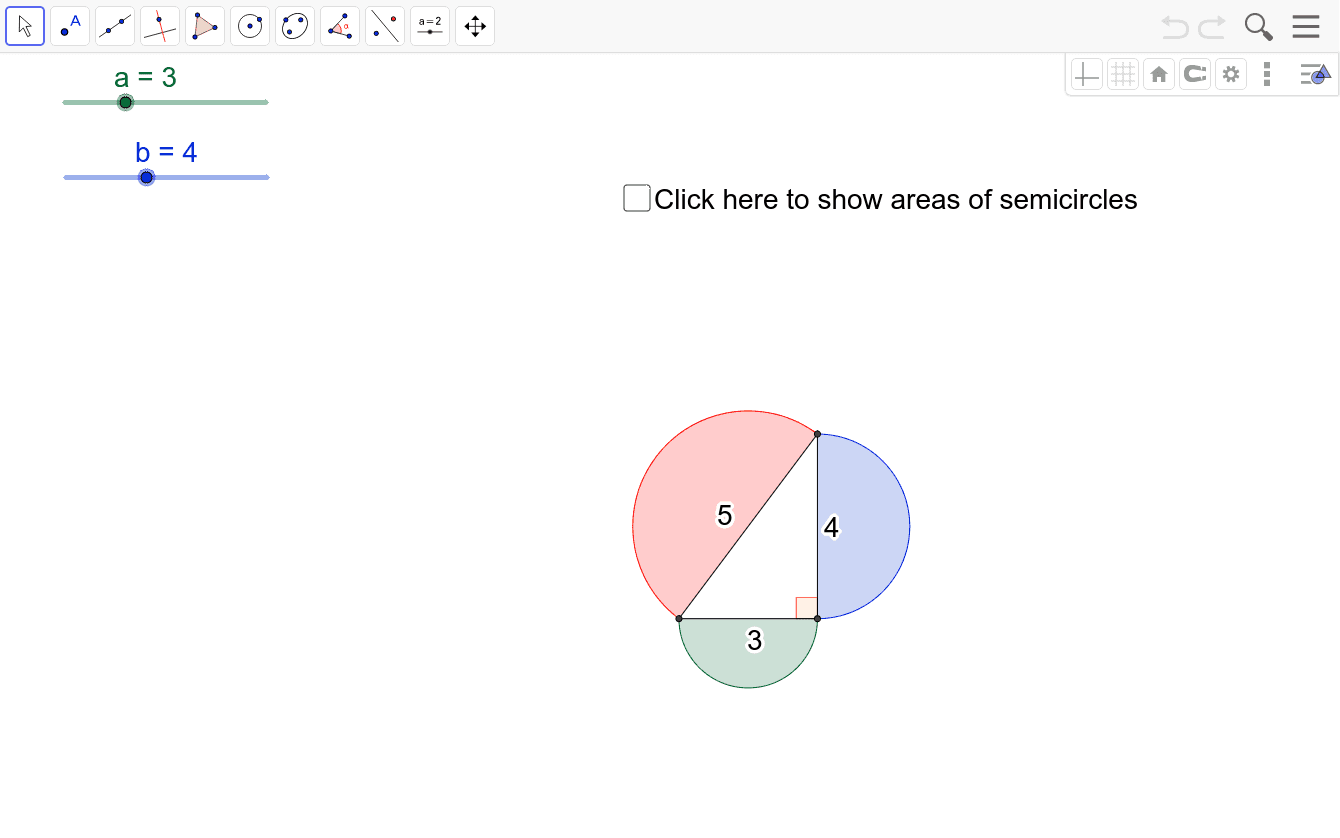
This GeoGebra example visualizes the Pythagorean theorem in an extended geometric form by constructing semicircles on each side of a right triangle. It demonstrates that the sum of the areas of the semicircles built on the two legs equals the area of the semicircle built on the hypotenuse, reinforcing the classic a² + b² = c² relationship through area equivalence. Core mathematical concepts include right triangle properties, circle area formulas, and the geometric interpretation of the Pythagorean theorem. The construction uses GeoGebra commands such as Intersect to define triangle vertices, Angle to mark the right angle, Segment to draw the triangle sides, and Semicircle to generate the three semicircles, along with text objects (text1, text2, text3) to display area values or relations. This resource is suitable for middle school to high school students learning the Pythagorean theorem and its geometric implications, and can be used in classroom demonstrations or exploratory activities to connect algebraic and geometric reasoning.
GeoGebra Commands & Parameters
Intersect(xAxis, yAxis) → AAngle(A, B, C) → αSegment(A, B) → sSegment(B, C) → tSegment(C, A) → cSemicircle(B, A) → eSemicircle(C, B) → fSemicircle(A, C) → g
AI Drawing Prompt Reference
Draw a right triangle ABC with A on the x-axis and B on the y-axis, then draw three semicircles e, f, and g with AB, BC, and CA as their diameters respectively, and mark the right angle ∠ABC.
The prompt above was compiled from the original drawing commands and is for reference only.