
Pythagoras Theorem by Similarity Ratios
Loading the math board and drawing, please wait…
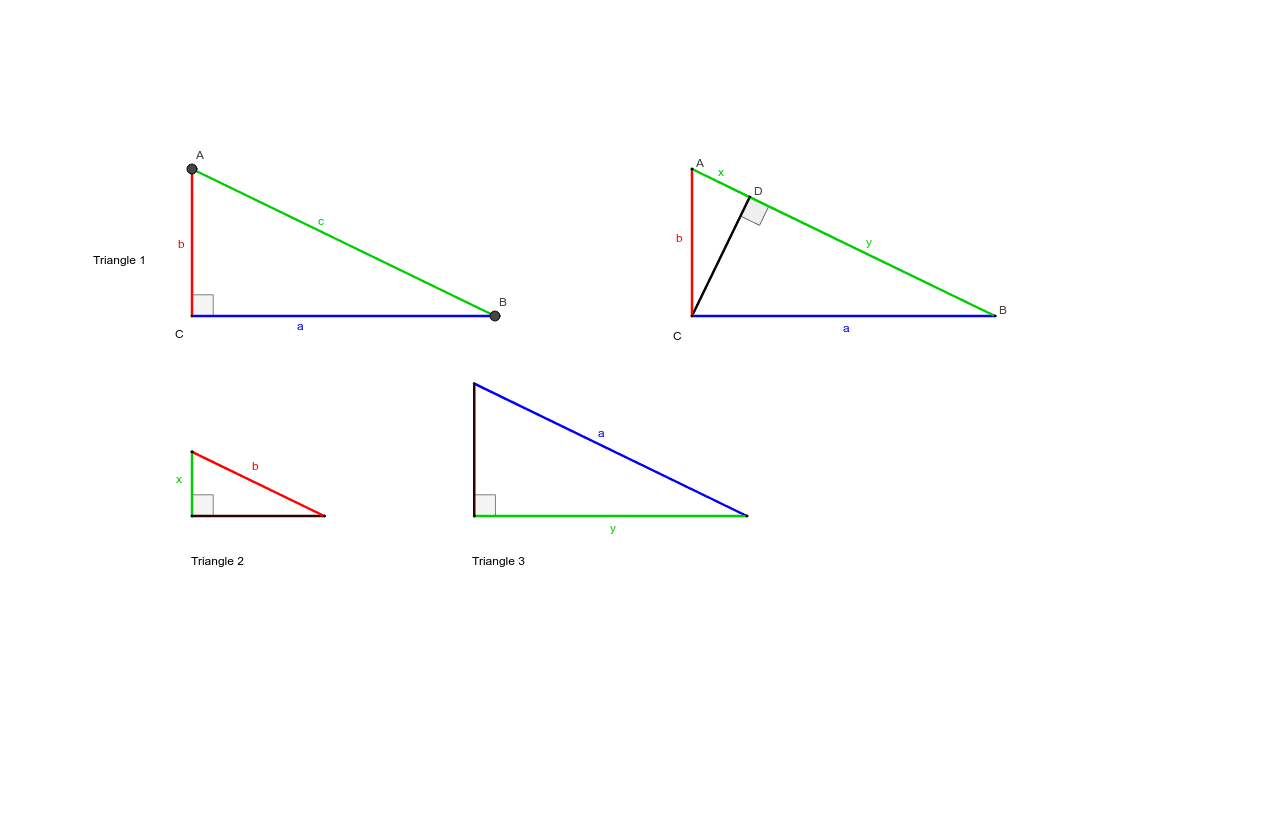
This example demonstrates the Pythagorean theorem through similarity ratios. It involves key mathematical concepts such as triangles, similarity ratios, and angles. Using GeoGebra commands like Segment, Polygon, Translate, Intersect, etc., a dynamic right triangle is constructed to show the relationship between the sides of a right triangle. Suitable for middle school and above students to learn geometric construction and properties of similar triangles.
GeoGebra Commands & Parameters
Segment(C, A) → bSegment(A, B) → cSegment(B, C) → aPolygon(A, C, B) → poly1, b_2, a_2, c_1Translate(A, Vector[(0, 0), (10, 0)]) → A'Translate(C, Vector[(0, 0), (10, 0)]) → C'Translate(B, Vector[(0, 0), (10, 0)]) → B'Polygon(A', C', B') → poly1', b', a', c'OrthogonalLine(C', c') → dIntersect(d, c') → DSegment(C', D) → eSegment(A', C') → fSegment(C', B') → hSegment(A', D) → iSegment(D, B') → gAngle(B, C, A) → αAngle(C', D, B') → βRotate(D, Angle[B', C', D], D) → D'Rotate(A', Angle[D, C', B'], C') → A''Rotate(D, Angle[D, C', B'], C') → D'_1Rotate(C', Angle[D, C', B'], C') → C''Polygon(A'', D'_1, C'') → poly2, c'', a'', d'_1Mirror(Polygon[Rotate[A', Angle[D, C', B'], C'], Rotate[D, Angle[D, C', B'], C'], Rotate[C', Angle[D, C', B'], C']], C) → poly3Angle(poly3) → γ, δ, εAngle(poly3) → ζ, η, θAngle(poly3) → ι, κ, λAngle(poly3) → μ, ν, ξMirror(A'', Line[A', C']) → A'''Mirror(D'_1, Line[A', C']) → EMirror(C'', Line[A', C']) → C'''Polygon(A''', E, C''') → poly2', c''', a''', e_1Translate(A''', Vector[E, (0, -4)]) → FTranslate(E, Vector[E, (0, -4)]) → E'Translate(C''', Vector[E, (0, -4)]) → GPolygon(F, E', G) → poly2'', g_1, f_1, e'Mirror(C', Line[C', B']) → C''_1Mirror(D, Line[C', B']) → D'_2Mirror(B', Line[C', B']) → B''Polygon(C''_1, D'_2, B'') → poly4, b'', c''_1, d'_2Translate(C''_1, Vector[D'_2, G + (3, 0)]) → HTranslate(D'_2, Vector[D'_2, G + (3, 0)]) → ITranslate(B'', Vector[D'_2, G + (3, 0)]) → B'''Polygon(H, I, B''') → poly4', b''', h_1, i_1Line(G, I) → jPoint(j) → JRotate(H, Angle[B''', I, J], I) → H'Rotate(I, Angle[B''', I, J], I) → I'Rotate(B''', Angle[B''', I, J], I) → KPolygon(H', I', K) → poly4'', k, h', i'Segment(F, E') → lSegment(E', G) → mSegment(F, G) → nSegment(H', K) → pSegment(H', I) → qSegment(I, K) → rAngle(G, E', F) → οAngle(K, I, H') → ρ