
Coordinates #7: Rhombus Translation Tracing Ellipse and Hyperbola
Loading the math board and drawing, please wait…
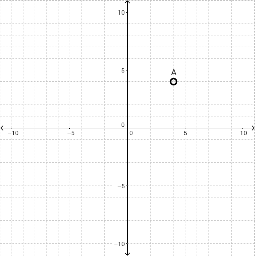
This example demonstrates the geometric phenomenon of tracing a vertex of a rhombus under translation in the coordinate plane. It involves core mathematical concepts such as coordinate geometry, definitions of ellipses and hyperbolas, properties of polygons (specifically rhombi), and translation transformations. The construction uses GeoGebra commands: points A and B are created, an ellipse and a hyperbola serve as reference curves, a translated point A_1 is generated, and the trace feature is enabled to visualize the locus of A_1 as it moves. Suitable for high school students studying analytic geometry, conic sections, and geometric transformations, as well as for teachers demonstrating dynamic trajectory formation in class.
GeoGebra Commands & Parameters
Point A(4, 4)((2 * x(A)), 0)Boolean trace(false)A + (0, 2)
AI Drawing Prompt Reference
In the coordinate plane, draw a rhombus with one vertex at point (4,4) and another vertex obtained by translating this point 2 units upward along the y-axis. Use the origin as the center to draw an ellipse and a hyperbola as reference curves, with the ellipse's major axis along the x-axis and the hyperbola's foci on the x-axis. Set the translated vertex as a dynamic point and enable its trace feature so that it leaves a trajectory as it moves, which should appear as part of an ellipse or hyperbola. The overall composition should clearly show the rhombus, the reference curves, and the moving point's path.
The prompt above was compiled from the original drawing commands and is for reference only.