
Pythagoras in a Box
Loading the math board and drawing, please wait…
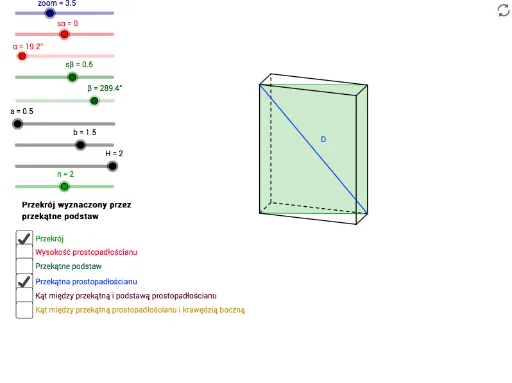
This example demonstrates geometric relationships constructed through three sections of a cube: midpoints of parallel edges, base diagonals, and side diagonals. Core math concepts include solid geometry, Pythagorean theorem, and vector operations. It uses GeoGebra commands like Midpoint, Odcinek_3D, If, Segment, and Angle. Suitable for high school geometry teaching to understand spatial geometric relationships and the extension of the Pythagorean theorem.
GeoGebra Commands & Parameters
Midpoint(D7, D8) → GMidpoint(D5, D6) → FMidpoint(D3, D4) → EMidpoint(D1, D2) → DOdcinek_3D(D8, D4, D7, D6) → c, dOdcinek_3D(D8, D6, D4, D7) → e, fOdcinek_3D(D8, D7, D6, D4) → g, hOdcinek_3D(D7, D3, D5, D8) → i, jOdcinek_3D(D7, D5, D8, D3) → k, lOdcinek_3D(D5, D1, D6, D7) → m, n_1Odcinek_3D(D5, D6, D7, D1) → p, qOdcinek_3D(D6, D2, D8, D5) → s, tOdcinek_3D(D2, D1, D4, D6) → a_1, b_1Odcinek_3D(D2, D4, D6, D1) → c_1, d_1Odcinek_3D(D1, D3, D2, D5) → e_1, f_1Odcinek_3D(D3, D4, D1, D7) → g_1, h_1If(n ≟ 1 ∧ p_1, Polygon[D, E, G, F]) → wielokąt1If(n ≟ 2 ∧ p_1, Polygon[D1, D4, D8, D5]) → wielokąt2If(n ≟ 3 ∧ p_1, Polygon[D1, D2, D8, D7]) → wielokąt3Segment(D, F) → i_1Segment(E, G) → j_1Segment(D, E) → k_1Segment(F, G) → l_1Segment(F, E) → m_1Angle(G, F, E) → γAngle(F, E, G) → δMidpoint(D1, D4) → BMidpoint(D5, D8) → CSegment(B, C) → s_1Segment(D1, D4) → t_1Segment(D5, D8) → a_2Segment(D5, D4) → b_2Angle(D8, D5, D4) → εAngle(D5, D4, D8) → ζSegment(D1, D8) → c_2Segment(D2, D8) → e_2Segment(D1, D7) → f_2Angle(D2, D8, D6) → ηAngle(D6, D2, D8) → θAngle(D7, D8, D1) → ιAngle(D7, D1, D8) → κ