
Pyramid Volume by Andreas Lindner
Loading the math board and drawing, please wait…
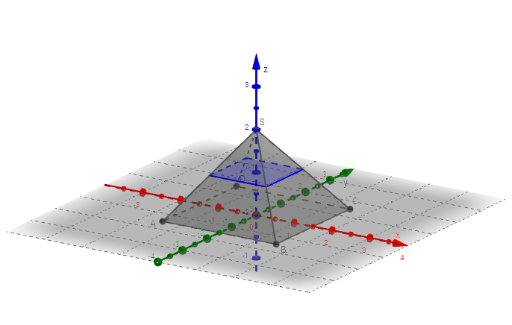
This example demonstrates the calculation of a pyramid's volume. Key mathematical concepts include the volume formula for a pyramid. Using GeoGebra commands like Polygon and Sequence, the example dynamically constructs a pyramid and calculates its volume. Suitable for high school mathematics education and learning.
GeoGebra Commands & Parameters
Pyramid(A, B, C, D, S) → pyr, FlächeABCD, KanteAS, KanteBS, KanteCS, KanteDS, FlächeABS, FlächeBCS, FlächeCDS, FlächeADS, KanteAB, KanteBC, KanteCD, KanteADPolygon(A_1, B_1, C_1, D_1) → Vieleck1, a_1, b_1, c_1, d_1Sequence(Prism[Polygon[(((-b((k * Δz)))) / 2, ((-b((k * Δz)))) / 2, (k * Δz)), (b((k * Δz)) / 2, ((-b((k * Δz)))) / 2, (k * Δz)), (b((k * Δz)) / 2, b((k * Δz)) / 2, (k * Δz)), (((-b((k * Δz)))) / 2, b((k * Δz)) / 2, (k * Δz))], (((-b((k * Δz)))) / 2, ((-b((k * Δz)))) / 2, ((k + 1) * Δz))], k, 0, m - 1) → Liste1
AI Drawing Prompt Reference
Draw a pyramid to demonstrate the calculation of its volume. The base is a quadrilateral, and the sides are four triangles. Dynamically construct the base and sides, labeling key geometric elements like edges and areas to visually show the application of the pyramid volume formula. Start by drawing the base quadrilateral, then add the four side triangles one by one, and finally label all edges and face areas, along with the volume calculation result.
The prompt above was compiled from the original drawing commands and is for reference only.