
Pyramid Surface Area Calculation
Loading the math board and drawing, please wait…
In collections
Surface Area
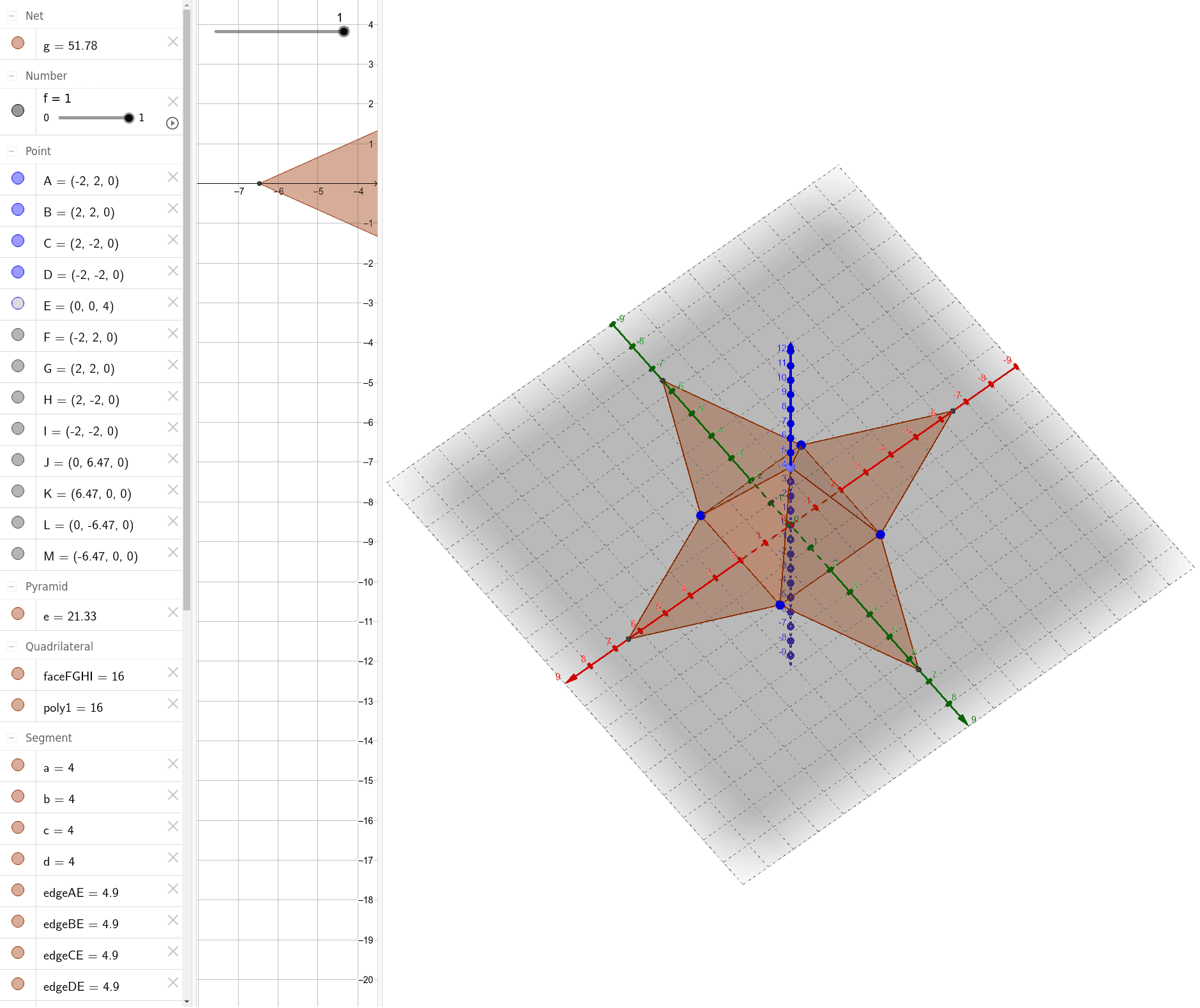
This example demonstrates how to calculate the surface area of a pyramid. It involves core mathematical concepts such as polygon area calculation, solid geometry, and geometric construction. Key GeoGebra commands and objects used include Polygon, Point, Pyramid, and Net for constructing the pyramid and its net. Suitable for high school students learning about surface area calculations in solid geometry.
GeoGebra Commands & Parameters
Polygon(A, B, C, D) → poly1, a, b, c, dPoint(zAxis) → EPyramid(poly1, E) → e, faceABE, faceBCE, faceCDE, faceADE, edgeAE, edgeBE, edgeCE, edgeDENet(e, f) → g, F, faceFGJ, faceGHK, faceHIL, faceFIM, edgeFG, edgeGH, edgeHI, edgeFI, edgeFJ, edgeGJ, G, edgeGK, edgeHK, edgeHL, edgeIL, edgeIM, edgeFM, H, I, J, K, L, M, faceFGHI
AI Drawing Prompt Reference
Draw a square pyramid with a quadrilateral base, then extend a vertical line from the center of the base to form the apex, connecting the apex to each vertex of the base to create the pyramid. Finally, show the net of the pyramid, which is a flat shape consisting of the base and four triangular faces, illustrating the surface area composition of the pyramid.
The prompt above was compiled from the original drawing commands and is for reference only.