
Pyramid Net Diagram
Loading the math board and drawing, please wait…
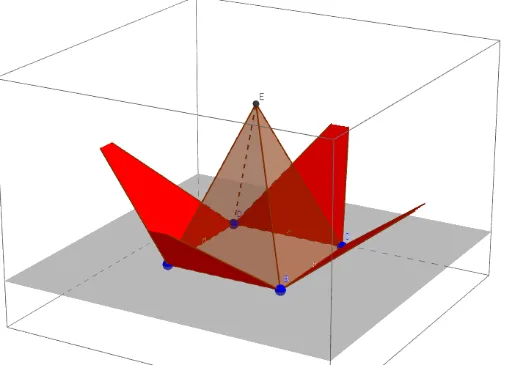
This example demonstrates the net diagram of a pyramid, showing how a 2D plane figure can be folded into a 3D pyramid. Core math concepts include polygons, solid geometry, and geometric construction. The construction uses GeoGebra commands like Polygon, Pyramid, and Net, along with points A, B, C, D, faces, and edges. Suitable for high school students learning solid geometry to understand the relationship between nets and 3D shapes, enhancing spatial reasoning.
GeoGebra Commands & Parameters
Polygon(A, B, C, D) → poly1, a, b, c, dPyramid(poly1, 5) → e, E, faceABE, faceBCE, faceCDE, faceADE, edgeAE, edgeBE, edgeCE, edgeDENet(e, f) → g, F, faceFGJ, faceGHK, faceHIL, faceFIM, edgeFG, edgeGH, edgeHI, edgeFI, edgeFJ, edgeGJ, G, edgeGK, edgeHK, edgeHL, edgeIL, edgeIM, edgeFM, H, I, J, K, L, M, faceFGHI
AI Drawing Prompt Reference
Draw the net diagram of a pyramid. Start with a quadrilateral base, then construct a pyramid with its apex above the base at a height of 5, showing all lateral faces and edges. Next, unfold the pyramid into a flat net, consisting of the base quadrilateral and four triangular faces connected along shared edges, with vertices labeled. This illustrates the folding relationship between a 3D solid and its 2D net, aiding spatial reasoning.
The prompt above was compiled from the original drawing commands and is for reference only.