
Pyramid Net by Arthur Lee
Loading the math board and drawing, please wait…
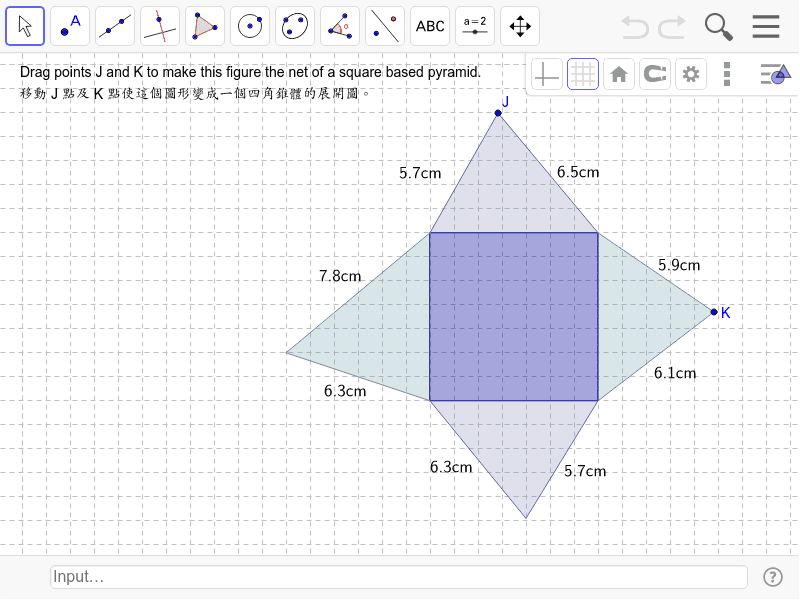
This example demonstrates the net of a pyramid and its geometric properties. It involves core math concepts like polygons, trapezoids, combinatorics, binomial distribution, and variance. Construction highlights include using commands such as Polygon, Segment, OrthogonalLine, Circle, Intersect, and Distance in GeoGebra. Suitable for high school and above students studying solid geometry and combinatorial mathematics.
GeoGebra Commands & Parameters
Polygon(A, B, 4) → poly1, a, b, c, d, C, DSegment(A, E) → eSegment(D, E) → fOrthogonalLine(E, d) → gOrthogonalLine(F, g) → hCircle(A, E) → kCircle(D, E) → pIntersect(p, h, 2) → HSegment(D, H) → iIntersect(k, h, 1) → GSegment(A, G) → jSegment(G, B) → lCircle(B, G) → qIntersect(q, g, 2) → ISegment(B, I) → mSegment(C, H) → nSegment(C, I) → rPolygon(D, J, C) → poly2, c_1, d_1, j_1Polygon(C, K, B) → poly3, b_1, c_2, k_1Polygon(E, D, A) → poly4, a_1, e_1, d_2Polygon(A, B, G) → poly5, g_1, a_2, b_2Distance(E, D) → distanceEDDistance(E, A) → distanceEADistance(A, G) → distanceAGDistance(G, B) → distanceGBDistance(D, J) → distanceDJDistance(C, J) → distanceCJDistance(C, K) → distanceCKDistance(K, B) → distanceKB
AI Drawing Prompt Reference
Draw the net of a pyramid. Start by drawing a square ABCD. Then, draw lines from points A and D to point E, where E is on the extension of AD. Next, draw perpendicular lines from E to the lines AD and DC, intersecting at points F and G. Draw circles with centers at A and D and radius AE, intersecting the perpendicular lines at points H and I. Connect DH and BI, then connect CI and BH. Finally, draw triangles DJC and KCB, and triangle AEF. Label the lengths of AE and DE.
The prompt above was compiled from the original drawing commands and is for reference only.