
Pyramid Dissection
Loading the math board and drawing, please wait…
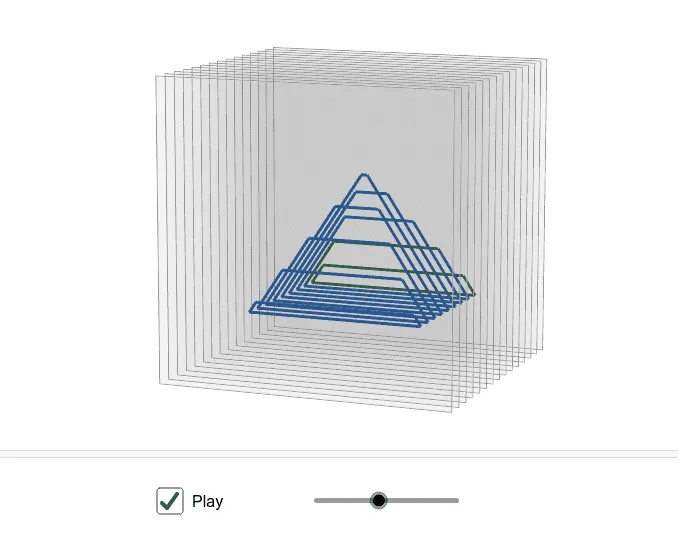
This example demonstrates the geometric dissection and artistic representation of a pyramid. It involves core mathematical concepts such as solid geometry, parametric equations, function graphing, and geometric construction. Key GeoGebra commands and objects used in the construction include Polygon, Translate, Plane, Centroid, Pyramid, and IntersectPath. Suitable for high school and above, it is ideal for learning solid geometry constructions, parametric equations, and optimization problems.
GeoGebra Commands & Parameters
Polygon(A, B, D, C) → p0, a, b, d, cTranslate(p0, Vector[(0, -1, 0), (0, (2 / n * (1 - 1)) - 1, 0)]) → P1Translate(p0, Vector[(0, -1, 0), (0, (2 / n * (2 - 1)) - 1, 0)]) → P2Translate(p0, Vector[(0, -1, 0), (0, (2 / n * (3 - 1)) - 1, 0)]) → P3Translate(p0, Vector[(0, -1, 0), (0, (2 / n * (4 - 1)) - 1, 0)]) → P4Translate(p0, Vector[(0, -1, 0), (0, (2 / n * (5 - 1)) - 1, 0)]) → P5Translate(p0, Vector[(0, -1, 0), (0, (2 / n * (6 - 1)) - 1, 0)]) → P6Translate(p0, Vector[(0, -1, 0), (0, (2 / n * (7 - 1)) - 1, 0)]) → P7Translate(p0, Vector[(0, -1, 0), (0, (2 / n * (8 - 1)) - 1, 0)]) → P8Translate(p0, Vector[(0, -1, 0), (0, (2 / n * (9 - 1)) - 1, 0)]) → P9Translate(p0, Vector[(0, -1, 0), (0, (2 / n * (10 - 1)) - 1, 0)]) → P10Translate(p0, Vector[(0, -1, 0), (0, (2 / n * (11 - 1)) - 1, 0)]) → P11Translate(p0, Vector[(0, -1, 0), (0, (2 / n * (12 - 1)) - 1, 0)]) → P12Translate(p0, Vector[(0, -1, 0), (0, (2 / n * (13 - 1)) - 1, 0)]) → P13Translate(p0, Vector[(0, -1, 0), (0, (2 / n * (14 - 1)) - 1, 0)]) → P14Translate(p0, Vector[(0, -1, 0), (0, (2 / n * (15 - 1)) - 1, 0)]) → P15Plane(P1) → PO1Plane(P2) → PO2Plane(P3) → PO3Plane(P4) → PO4Plane(P5) → PO5Plane(P6) → PO6Plane(P7) → PO7Plane(P8) → PO8Plane(P9) → PO9Plane(P10) → PO10Plane(P11) → PO11Plane(P12) → PO12Plane(P13) → PO13Plane(P14) → PO14Plane(P15) → PO15Polygon((o, (-o) + t, (-o)), ((-o), (-o) + t, (-o)), ((-o), o + t, (-o)), (o, o + t, (-o))) → base, f, g, h, iCentroid(base) → TPyramid(base, (x(T), y(T), z(T) + 0.9)) → s, face1, face3, face4, face2, edge1, edge2, edge3, edge4IntersectPath(PO1, s) → S1_1, F_2, G_2, H_2, I_2, h_3, i_3, j_3, k_3IntersectPath(PO2, s) → S2_1, B_2, C_2, D_2, E_2, d_2, e_2, f_3, g_3IntersectPath(PO3, s) → S3_1, V_1, W_1, Z_1, A_2, t_2, a_2, b_2, c_2IntersectPath(PO4, s) → S4_1, E, F, T_1, U_1, j, k, r_2, s_2IntersectPath(PO5, s) → S5_1, G, H, I, J, l, m, p, qIntersectPath(PO6, s) → S6_1, K, L, M, N, r, e, f_1, g_1IntersectPath(PO7, s) → S7_1, O, P, Q, R, h_1, i_1, j_1, k_1IntersectPath(PO8, s) → S8_1, S, U, V, W, l_1, m_1, n_1, p_1IntersectPath(PO9, s) → S9_1, Z, A_1, B_1, C_1, q_1, r_1, s_1, t_1IntersectPath(PO10, s) → S10_1, D_1, E_1, F_1, G_1, a_1, b_1, c_1, d_1IntersectPath(PO11, s) → S11_1, H_1, I_1, J_1, K_1, e_1, f_2, g_2, h_2IntersectPath(PO12, s) → S12_1, L_1, M_1, N_1, O_1, i_2, j_2, k_2, l_2IntersectPath(PO13, s) → S13_1, P_1, Q_1, R_1, S_1, m_2, n_2, p_2, q_2IntersectPath(PO14, s) → S14_1, J_2, K_2, L_2, M_2, l_3, m_3, n_3, p_3IntersectPath(PO15, s) → S15_1, N_2, O_2, P_2, Q_2, q_3, r_3, s_3, t_3