
Pyramid Cross Section Similarity
Loading the math board and drawing, please wait…
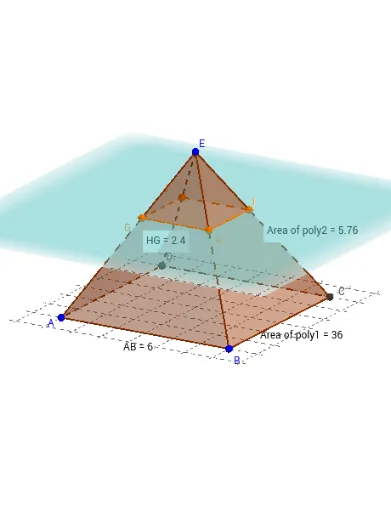
This example demonstrates the process of cutting a pyramid with a plane parallel to its base. Key mathematical concepts include similarity and solid geometry. Using GeoGebra commands such as PointIn, Polygon, Pyramid, Translate, and IntersectPath, the construction of the pyramid and its cross-section is illustrated. Suitable for students at the junior high school level and above.
GeoGebra Commands & Parameters
PointIn(xOyPlane) → BPointIn(xOyPlane) → APolygon(A, B, 4, xOyPlane) → poly1, a, b, c, d, C, DPyramid(poly1, E) → e, faceABE, faceBCE, faceCDE, faceADE, edgeAE, edgeBE, edgeCE, edgeDETranslate(xOyPlane, Vector[(0, 0, 3)]) → fIntersectPath(f, e) → poly2, poly3, g, h, i, j, k, l, m, n, G, H, I, J, K, L, M, NPointIn(poly2) → Pointpoly2PointIn(poly1) → Pointpoly1Distance(A, B) → distanceABDistance(H, G) → distanceHGPerimeter(faceABE) → perimeterfaceABE
AI Drawing Prompt Reference
Draw a pyramid and cut it with a plane parallel to its base to form two similar cross-sections. First, create four points A, B, C, D on the xOy plane, then use these points and point E to construct the pyramid. Next, translate the xOy plane 3 units along the z-axis to get a new plane f, and use f to intersect with the pyramid edge e to form two similar cross-sections poly2 and poly3. Finally, select a point on each section and measure the perimeter of triangle ABE and triangle HGE, as well as the lengths of AB and HG.
The prompt above was compiled from the original drawing commands and is for reference only.