
Puzzle 1: Parkland College Opening Puzzle
Loading the math board and drawing, please wait…
This GeoGebra example presents an interactive puzzle that combines logical reasoning with function graphing, guiding users to explore polynomial functions, real number properties, and set-theoretic relationships. The core mathematical concepts include the behavior of polynomial functions, extrema (Min/Max) on the real numbers, conditional logic via If statements, and foundational ideas from statistics and set theory. The construction uses commands such as Segment, Point, Min, Max, and If, with objects A, B, f, C, D, a, b, s1, s2, s3, and text1, where f likely represents a polynomial function, s1-s3 may be statistical or set-related objects, and text1 displays hints or conclusions. This is suitable for high school or early college students for training logical thinking, integrating functions and sets, and can serve as an engaging interactive puzzle for math competitions.
GeoGebra Commands & Parameters
Segment((0, 0), (3, 0)) → fPoint(f) → CPoint(f) → DMin(x(C), x(D)) → aMax(x(C), x(D)) → bIf(s1 + s2 > s3 ∧ s2 + s3 > s1 ∧ s3 + s1 > s2, "Yes!", "No!") → text1
AI Drawing Prompt Reference
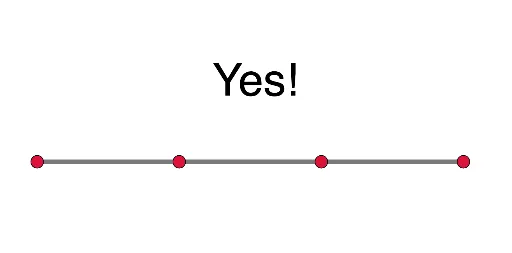
Draw a horizontal line segment from the origin to (3,0), mark two points C and D on the segment, and identify the minimum and maximum x-coordinates of C and D as points a and b respectively. Display 'Yes!' or 'No!' next to the graph based on the relationship among three conditional objects s1, s2, and s3.
The prompt above was compiled from the original drawing commands and is for reference only.