
Putting It All Together: Geometric Construction Linked to Statistical Ideas
Loading the math board and drawing, please wait…
In collections
Simplifying Radicals: Geometric Thin Slice
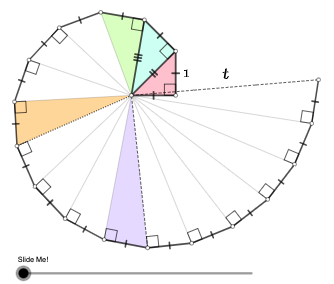
This example demonstrates how multiple geometric elements are assembled to highlight measurable relationships, visually connecting construction-based geometry with the statistical viewpoint of a median and boxplot-style summaries. The key math concepts include the Pythagorean theorem (right-triangle length relations), trigonometry via sine/angle relationships, rational-number computability for constructed measures, and the median idea used in boxplots. Construction-wise, it uses Polygon and Segment to build shapes and edges, Line and Point to define reference geometry, Circle and Intersect to enforce circular constraints and compute key intersection points, OrthogonalLine to create perpendicular structure, and Angle to mark the critical angle for trigonometric interpretation. It further employs Midpoint, Vector, Rotate, Dilate, and Translate (plus RotateText) to position and transform points while preserving the intended relationships. Named objects (e.g., A, B, C, and multiple derived points) reflect a step-by-step workflow from base geometry to aggregated/summary representations. Suitable for secondary school geometry-and-functions lessons and for introductory math visualization or data-science oriented instruction.
GeoGebra Commands & Parameters
Polygon(A, B, C) → t1, c, a, bOrthogonalLine(C, b) → fCircle(C, 1) → dIntersect(d, f, 1) → DSegment(A, D) → gOrthogonalLine(D, g) → hCircle(D, 1) → eIntersect(e, h, 2) → ESegment(A, E) → iOrthogonalLine(E, i) → jCircle(E, 1) → kIntersect(k, j, 2) → FSegment(A, F) → lOrthogonalLine(F, l) → mCircle(F, 1) → pIntersect(p, m, 2) → GSegment(A, G) → nOrthogonalLine(G, n) → qCircle(G, 1) → rIntersect(r, q, 2) → HSegment(A, H) → sOrthogonalLine(H, s) → tCircle(H, 1) → c_1Intersect(c_1, t, 2) → ISegment(A, I) → f_1OrthogonalLine(I, f_1) → g_1Circle(I, 1) → d_1Intersect(d_1, g_1, 2) → JSegment(A, J) → h_1OrthogonalLine(J, h_1) → i_1Circle(J, 1) → e_1Intersect(e_1, i_1, 2) → KSegment(A, K) → j_1OrthogonalLine(K, j_1) → k_1Circle(K, 1) → p_1Intersect(p_1, k_1, 2) → LSegment(A, L) → l_1OrthogonalLine(L, l_1) → m_1Circle(L, 1) → q_1Intersect(q_1, m_1, 2) → MSegment(A, M) → n_1OrthogonalLine(M, n_1) → r_1Circle(M, 1) → s_1Intersect(s_1, r_1, 2) → NSegment(A, N) → t_1OrthogonalLine(N, t_1) → a_1Circle(N, 1) → c_2Intersect(c_2, a_1, 2) → OSegment(A, O) → b_1OrthogonalLine(O, b_1) → f_2Circle(O, 1) → d_2Intersect(d_2, f_2, 2) → PSegment(A, P) → g_2OrthogonalLine(P, g_2) → h_2Circle(P, 1) → e_2Intersect(e_2, h_2, 2) → QSegment(A, Q) → i_2OrthogonalLine(Q, i_2) → j_2Circle(Q, 1) → k_2Intersect(k_2, j_2, 2) → RSegment(A, R) → l_2Segment(C, D) → m_2Segment(D, E) → n_2Segment(E, F) → p_2Segment(F, G) → q_2Segment(G, H) → r_2Segment(H, I) → s_2Segment(I, J) → t_2Segment(J, K) → a_2Segment(K, L) → b_2Segment(L, M) → f_3Segment(M, N) → g_3Segment(N, O) → h_3Segment(O, P) → i_3Segment(P, Q) → j_3Segment(Q, R) → k_3Angle(C, B, A) → αAngle(D, C, A) → βAngle(E, D, A) → γAngle(F, E, A) → δAngle(G, F, A) → εAngle(H, G, A) → ζAngle(I, H, A) → ηAngle(J, I, A) → θAngle(K, J, A) → ιAngle(L, K, A) → κAngle(M, L, A) → λAngle(N, M, A) → μAngle(O, N, A) → νAngle(P, O, A) → ξAngle(Q, P, A) → οAngle(R, Q, A) → ρSegment(A, B) → l_3Segment(C, B) → m_3Segment(C, A) → n_3RotateText(text1_{1}, atand(Slope[n_3])) → text2RotateText(text3, atand(Slope[g])) → text4Midpoint(f_1) → SMidpoint(n_1) → TRotateText(text5, pi / 4) → text6RotateText(text7, atan(Slope[g])) → text8RotateText(text9, atand(Slope[i])) → text10Rotate(D, If[0 < o ≤ 1, ((-o) * pi / 3), ((-pi)) / 3], E) → D'Rotate(E, If[0 < o ≤ 1, ((-o) * pi / 3), ((-pi)) / 3], E) → E'Segment(D', E') → p_3Rotate(D', If[1 < o ≤ 2, ((-(o - 1)) * pi), (-pi)], D') → D''Rotate(E', If[1 < o ≤ 2, ((o - 1) * pi), pi], D') → E''Segment(D'', E'') → q_3Dilate(A, If[3 < o ≤ 4, 4 - o, 0], I) → A'Vector(A, A') → uTranslate(C, u) → C'Translate(A, u) → A'_{1}Segment(C', A'_{1}) → r_3Translate(C, u) → C'_{1}Angle(A, I, C'_{1}) → σRotate(C', If[4 < o ≤ 5, ((-(o - 4)) * σ), (-σ)], I) → C''Rotate(A'_{1}, If[4 < o ≤ 5, ((-(o - 4)) * σ), (-σ)], I) → USegment(C'', U) → s_3Segment(A, S) → t_3Segment(S, I) → a_3Rotate(C'', If[5 < o ≤ 6, ((o - 5) * pi), pi], S) → C'''Rotate(U, If[5 < o ≤ 6, ((o - 5) * pi), pi], S) → U'Segment(C''', U') → b_3Angle(I, A, M) → τRotate(U', If[7 < o ≤ 8, ((o - 7) * τ), τ], A) → U''Dilate(A, If[7 < o ≤ 8, 8 - o, 0], M) → A'_{2}Vector(A, A'_{2}) → vTranslate(A, v) → A'_{3}Translate(D, v) → D'_{1}Segment(A'_{3}, D'_{1}) → g'Segment(M, T) → c_3Segment(T, A) → d_3Line(M, A) → e_3Point(e_3) → VAngle(D, A, V) → χRotate(A'_{3}, If[8 < o ≤ 9, ((o - 8) * χ), χ], M) → WRotate(D'_{1}, If[8 < o ≤ 9, ((o - 8) * χ), χ], M) → ZSegment(W, Z) → g''Rotate(W, If[9 < o ≤ 10, ((o - 9) * pi), pi], Z) → W'Rotate(Z, If[9 < o ≤ 10, ((o - 9) * pi), pi], Z) → Z'Segment(W', Z') → g'''Polygon(A, B, C) → t2, c_4, a_4, b_4Polygon(A, C, D) → t3, d_4, a_5, c_5Polygon(A, D, E) → t4, e_4, a_6, d_5OrthogonalLine(R, l_2) → f_4Circle(R, 1) → g_4Intersect(g_4, f_4, 2) → A_1Segment(A, A_1) → h_4Segment(A_1, R) → i_4Angle(A_1, R, A) → υCircle(A, Distance[A, C]) → k_4Intersect(k_4, h_4, 1) → B_1Circle(B_1, Distance[A, C]) → p_4Intersect(p_4, h_4, 2) → C_1Segment(A, B_1) → j_4Segment(B_1, C_1) → l_4Segment(C_1, A_1) → m_4Polygon(A, H, I) → t5, i_5, a_7, h_5Polygon(A, L, M) → t6, m_5, a_8, l_5Line(A_1, A) → n_4Point(n_4) → D_1Angle(C, A, D_1) → ϕDilate(A, If[11 < o ≤ 12, 12 - o, 0], C_1) → A'_{4}Vector(A, A'_{4}) → wTranslate(C, w) → C'_{2}Translate(A, w) → A'_{5}Segment(C'_{2}, A'_{5}) → q_4Angle(A_1, A'_{4}, C'_{2}) → ψRotate(C'_{2}, If[12 < o ≤ 13, ((o - 12) * ϕ), ϕ], C_1) → E_1Rotate(A'_{5}, If[12 < o ≤ 13, ((o - 12) * ϕ), ϕ], C_1) → F_1Segment(E_1, F_1) → r_4Rotate(E_1, If[13 < o ≤ 14, ((-(o - 13)) * pi), (-pi)], A'_{5}) → G_1Rotate(F_1, If[13 < o ≤ 14, ((-(o - 13)) * pi), (-pi)], A'_{5}) → H_1Segment(G_1, H_1) → s_4Rotate(E_1, If[14 < o ≤ 15, ((o - 14) * pi), pi], E_1) → I_1Rotate(F_1, If[14 < o ≤ 15, ((o - 14) * pi), pi], E_1) → J_1Segment(I_1, J_1) → t_4RotateText(text12, atand(Slope[l_4])) → text13
AI Drawing Prompt Reference
Draw a geometric figure consisting of multiple squares and circles arranged in a step-like structure. Each square is connected to a circle of radius 1 via a vertical line. The figure starts from a point A and connects to the vertices of each square and circle, forming a closed path. The overall structure is symmetric and suitable for teaching geometry and statistics.
The prompt above was compiled from the original drawing commands and is for reference only.