
Proving Triangles Similar with Transformations
Loading the math board and drawing, please wait…
In collections
Proving Figures Similar
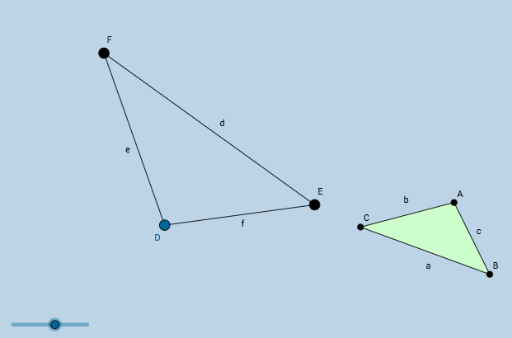
This example demonstrates proving triangles similar using geometric transformations. It covers concepts such as translation, rotation, reflection, and dilation. By constructing geometric objects like rays, angles, points, segments, and polygons, the transformation process is illustrated. Suitable for middle school and above students to learn about the properties of similar triangles.
GeoGebra Commands & Parameters
Ray(D, E) → f_2Rotate(E, (a_2 * π / 180), D) → B'Angle(E, D, B') → αRay(D, B') → gPoint(g) → FSegment(F, E) → dSegment(D, E) → fPolygon(D, E, F) → poly1, c_1, a_1, b_1Segment(D, F) → eAngle(F, E, D) → βPoint(e) → D_1Line(D_1, d) → kIntersect(k, f) → E_1Line(I, J) → nMirror(E_1, n) → E'Mirror(D_1, n) → D'Mirror(D, n) → A'Mirror(E, n) → B'_1Mirror(F, n) → C'Polygon(A', B'_1, C') → poly1', c', a', b'_1Rotate(A', (m * π / 180), A') → ARotate(B'_1, (m * π / 180), A') → F_1Rotate(C', (m * π / 180), A') → C''Polygon(A, F_1, C'') → poly1'', c'', a'', f_1Dilate(A, d_1, A) → A'''Dilate(F_1, d_1, A) → BDilate(C'', d_1, A) → CPolygon(A''', B, C) → poly1''', c''', a''', f'Segment(A, C) → bSegment(A, B) → cSegment(B, C) → a