
Proving Triangles Similar with Geometric Transformations (3)
Loading the math board and drawing, please wait…
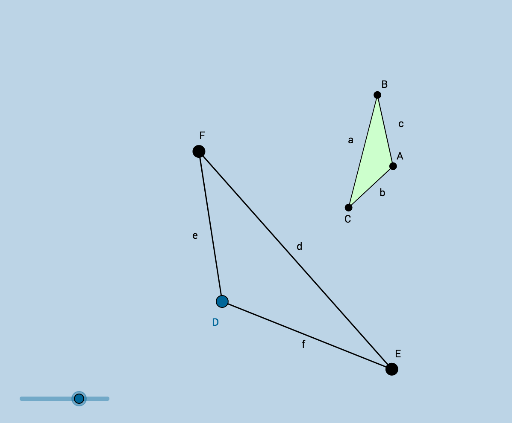
This example demonstrates how to prove triangle similarity using geometric transformations like dilation, reflection, rotation, and translation with GeoGebra. Key math concepts include geometric transformations, similarity criteria for triangles, and properties of polygons. Construction highlights involve commands such as Ray, Rotate, Angle, Point, Segment, Polygon, Vector, Translate, and Dilate to create and transform shapes, illustrating conditions for triangle similarity. Suitable for high school geometry and transformation studies.
GeoGebra Commands & Parameters
Ray(D, E) → f_2Rotate(E, (a_3 * π / 180), D) → B'Angle(E, D, B') → αRay(D, B') → gPoint(g) → FSegment(F, E) → dSegment(D, E) → fPolygon(D, E, F) → poly1, c_2, a_1, b_2Segment(D, F) → eAngle(F, E, D) → βVector(D_1, E_1) → uPolygon(D, E, F) → poly2, c_1, a_2, b_1Translate(D, u) → A'Translate(E, u) → B'_1Translate(F, u) → C'Polygon(A', B'_1, C') → poly2', c', a', b'_1Dilate(A', d_1, A') → A''Dilate(B'_1, d_1, A') → F_1Dilate(C', d_1, A') → CPolygon(A'', F_1, C) → poly2'', c'', a'', f_1Segment(A', C) → kSegment(C, F_1) → lSegment(F_1, A') → mRotate(A'', (e_1 * π / 180), C) → A'''Rotate(F_1, (e_1 * π / 180), C) → BRotate(C, (e_1 * π / 180), C) → C'''Polygon(A''', B, C''') → poly2''', c''', a_4, f'Rotate(A', (e_1 * π / 180), C) → ASegment(A, B) → cSegment(B, C) → aSegment(C, A) → b