
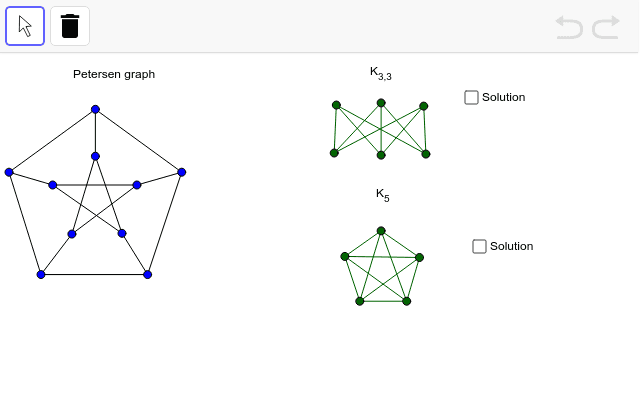
Proving the Petersen Graph is Non-Planar
Loading the math board and drawing, please wait…
In collections
Graph theory
This example demonstrates how to prove the Petersen graph is non-planar by constructing minors K₅ or K₃,₃. Key math concepts include graph theory, planarity, and minor properties. GeoGebra commands like Polygon and Segment are used, with objects such as w, A series points, and poly1/poly2 to build the graph and subgraphs. Suitable for high school students and graph theory learners exploring planar graph criteria.
GeoGebra Commands & Parameters
Polygon(H, I, 4) → poly1, s, t, b_1, c_1, J, KPolygon(J, I, 4) → poly2, d_1, e_1, f_1, g_1, L, MSegment(A_6, A_7) → a_1Segment(A_7, A_8) → a_2Segment(A_8, A_9) → a_3Segment(A_9, A_1) → a_4Segment(A_1, A_6) → a_7Segment(A_6, A_0) → a_5Segment(A_1, A_4) → a_6Segment(A_9, A_2) → a_8Segment(A_8, A_5) → a_9Segment(A_7, A_3) → a_{10}Segment(A_0, A_2) → a_{11}Segment(A_2, A_3) → a_{12}Segment(A_3, A_4) → a_{13}Segment(A_4, A_5) → a_{14}Segment(A_5, A_0) → a_0Segment(K11_2, K14_2) → k_{18}Segment(K13_2, O_2) → kSegment(K14_2, K13_2) → k_7Segment(K11_2, O_2) → k_{13}Segment(A, K14_2) → k_2Segment(A, O_2) → k_3Segment(B, K13_2) → k_4Segment(B, K11_2) → k_5Segment(A, B) → k_6Segment(C, D) → k_8Segment(D, E) → k_9Segment(G, F) → k_{10}Segment(F, E) → k_{11}Segment(G, C) → k_{12}Segment(C, E) → k_1Segment(F, D) → k_{14}Segment(G, E) → k_{15}Segment(D, G) → k_{16}Segment(F, C) → k_{17}Segment(A_{10}, A_{11}) → a_{15}Segment(A_{11}, A_{12}) → a_{16}Segment(A_{12}, A_{13}) → a_{17}Segment(A_{13}, A_{14}) → a_{18}Segment(A_{14}, A_{10}) → a_{19}Segment(A_{10}, A_{15}) → a_{20}Segment(A_{14}, A_{19}) → a_{21}Segment(A_{13}, A_{18}) → a_{22}Segment(A_{12}, A_{17}) → a_{23}Segment(A_{11}, A_{16}) → a_{24}Segment(A_{15}, A_{18}) → a_{25}Segment(A_{18}, A_{16}) → a_{26}Segment(A_{16}, A_{19}) → a_{27}Segment(A_{19}, A_{17}) → a_{28}Segment(A_{17}, A_{15}) → a_{29}Segment(A_{20}, A_{21}) → a_{30}Segment(A_{21}, A_{22}) → a_{31}Segment(A_{22}, A_{23}) → a_{32}Segment(A_{23}, A_{24}) → a_{33}Segment(A_{24}, A_{20}) → a_{34}Segment(A_{20}, A_{25}) → a_{35}Segment(A_{24}, A_{29}) → a_{36}Segment(A_{23}, A_{28}) → a_{37}Segment(A_{22}, A_{27}) → a_{38}Segment(A_{21}, A_{26}) → a_{39}Segment(A_{25}, A_{28}) → a_{40}Segment(A_{28}, A_{26}) → a_{41}Segment(A_{26}, A_{29}) → a_{42}Segment(A_{29}, A_{27}) → a_{43}Segment(A_{27}, A_{25}) → a_{44}
AI Drawing Prompt Reference
Draw the Petersen graph and demonstrate how it is non-planar by constructing minors K5 or K3,3. Start by creating two quadrilaterals, then connect a series of points to form the edges of the Petersen graph. Add extra segments to connect these points, forming the structure of K5 or K3,3 as subgraphs to prove the non-planarity of the Petersen graph.
The prompt above was compiled from the original drawing commands and is for reference only.