
Four Color Theorem
Loading the math board and drawing, please wait…
In collections
Graph theory
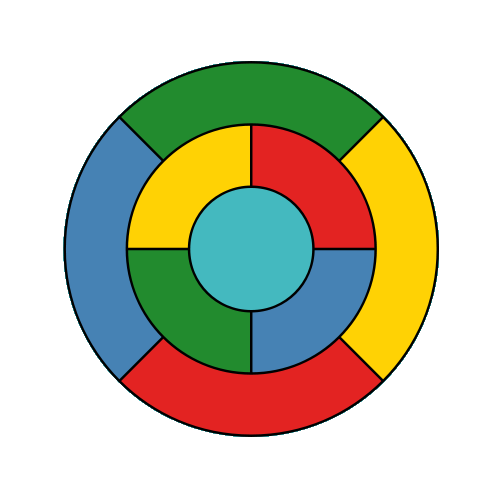
This example demonstrates how to color a map using only four colors to ensure that no two adjacent regions have the same color. The core mathematical concepts include coloring problems in graph theory. Using commands like Polygon, Point, Rotate, and Segment, a complex map can be constructed and colored. Suitable for high school and above students to learn graph theory and combinatorics.
GeoGebra Commands & Parameters
Polygon(C, D, 4) → poly1, a, b, c, d, E, FPoint(Circle[G, a]) → HRotate(H + (b, 0), Angle[E - D] + Angle[H - G] - Angle[D - C], H) → IRotate(I + (c, 0), Angle[F - E] + Angle[I - H] - Angle[E - D], I) → JPolygon(G, H, I, J) → poly2, g, h, i, jPoint(Circle[K, g]) → LPoint(Circle[S, a]) → TSegment(G_{18}, G_{19}) → e_4Segment(G_{19}, G_{20}) → e_5Segment(G_{20}, G_{21}) → e_9Segment(G_{21}, G_{18}) → e_1Segment(G_{22}, G_{21}) → e_2Segment(G_{22}, G_{18}) → e_{18}Segment(G_{23}, G_{22}) → e_{13}Segment(G_{23}, G_{24}) → e_{16}Segment(G_{24}, G_{25}) → e_{14}Segment(G_{22}, G_{25}) → e_{17}Segment(G_{18}, G_{25}) → e_3Segment(G_{25}, G_{19}) → e_{15}Segment(G_{24}, G_{20}) → e_7Segment(G_{23}, G_{20}) → e_8Segment(G_{23}, G_{21}) → e_{10}Segment(G_{24}, G_{19}) → e_6Segment(G_{26}, G_{22}) → e_{12}Segment(G_{23}, G_{26}) → e_{11}Segment(G_{26}, G_{25}) → eSegment(G_{26}, G_{24}) → e_{19}Rotate(L + (h, 0), Angle[I - H] + Angle[L - K] - Angle[H - G], L) → MRotate(M + (i, 0), Angle[J - I] + Angle[M - L] - Angle[I - H], M) → NPolygon(K, L, M, N) → poly3, k, l, m, nPoint(Circle[O, a]) → PRotate(P + (b, 0), Angle[E - D] + Angle[P - O] - Angle[D - C], P) → QRotate(Q + (c, 0), Angle[F - E] + Angle[Q - P] - Angle[E - D], Q) → RPolygon(O, P, Q, R) → poly4, o, p, q, rRotate(T + (b, 0), Angle[E - D] + Angle[T - S] - Angle[D - C], T) → URotate(U + (c, 0), Angle[F - E] + Angle[U - T] - Angle[E - D], U) → VPolygon(S, T, U, V) → poly5, s_1, t, u, v