
Nonplanar Graphs
Loading the math board and drawing, please wait…
In collections
Graph theory
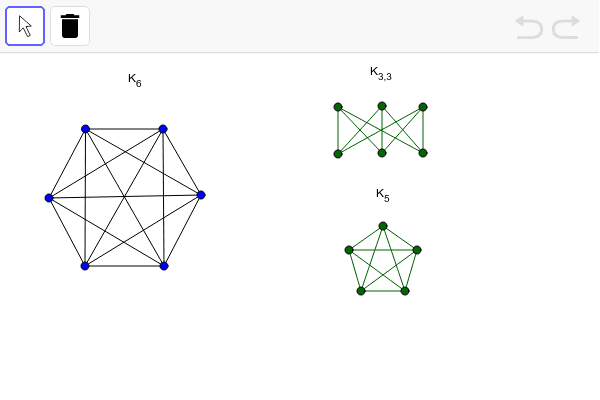
This example demonstrates the concept of nonplanar graphs by transforming K_6 to reveal subgraphs K_{3,3} and K_5. Key math concepts include planarity in graph theory, Kuratowski's theorem, and minor graphs. Construction involves commands like Segment, and objects such as text1_1, text2_1, K11_2, K13_2, etc., to draw and annotate the graphs, with r_3, K_7, and others aiding transformations. Suitable for high school and above, focusing on graph theory fundamentals and complex graph analysis.
GeoGebra Commands & Parameters
Segment(K11_2, K14_2) → r_3Segment(K13_2, K_7) → t_3Segment(K14_2, K13_2) → f_2Segment(K11_2, K_7) → g_2Segment(K_4, K14_2) → aSegment(K_4, K_7) → bSegment(K_3, K13_2) → cSegment(K_3, K11_2) → dSegment(K_4, K_3) → fSegment(K_1, K_2) → eSegment(K_2, K_6) → gSegment(K, K_5) → hSegment(K_5, K_6) → iSegment(K, K_1) → jSegment(K_1, K_6) → kSegment(K_5, K_2) → lSegment(K, K_6) → mSegment(K_2, K) → nSegment(K_5, K_1) → pSegment(A_{0}, A_{1}) → a_{0}Segment(A_{1}, A_{2}) → a_{1}Segment(A_{2}, A_{3}) → a_{2}Segment(A_{0}, A_{4}) → a_{3}Segment(A_{4}, A_{5}) → a_{4}Segment(A_{5}, A_{3}) → a_{5}Segment(A_{4}, A_{2}) → a_{6}Segment(A_{1}, A_{5}) → a_{7}Segment(A_{3}, A_{0}) → a_{8}Segment(A_{1}, A_{3}) → a_{9}Segment(A_{0}, A_{5}) → a_{10}Segment(A_{3}, A_{4}) → a_{11}Segment(A_{5}, A_{2}) → a_{12}Segment(A_{4}, A_{1}) → a_{13}Segment(A_{2}, A_{0}) → a_{14}