
Proportions in Similar Triangles by Mathguru
Loading the math board and drawing, please wait…
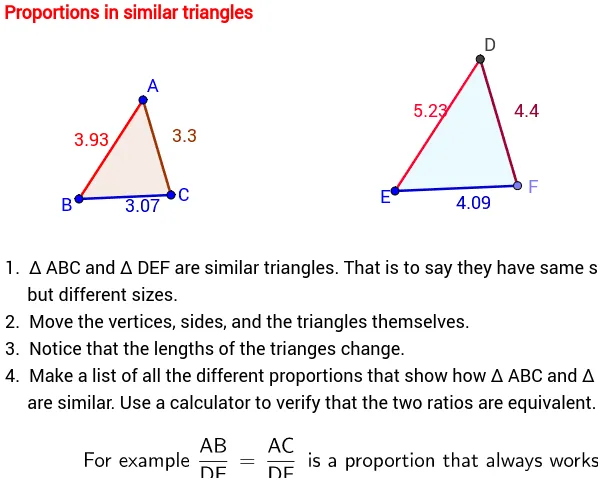
① This example demonstrates the constant ratio of corresponding sides in two similar triangles.② Core math concepts: similar triangles, equal corresponding angles, side‑length proportions, similarity transformations.③ Construction highlights: Polygon creates the triangles; Point, Line, Angle define vertices, edges, and angles; Rotate applies the similarity transformation; Intersect finds intersection points. Objects include vertices A, B, C, P; edges a, b, c, d, e, h, i; angles α, β, γ, δ, ε; auxiliary points D, E, F, G, Q, F₁ and labels T1‑T4.④ Suitable for middle‑school geometry (similar triangles) and high‑school analytic geometry instruction, as well as self‑study exploration.
GeoGebra Commands & Parameters
Polygon(A, B, C) → P, c, a, bAngle(P) → α, β, γLine(B, C) → dLine(E, d) → ePoint(e) → FRotate(F, β, E) → GAngle(F, E, G) → δRotate(E, -γ, F) → F_1Angle(F_1, F, E) → εLine(E, G) → hLine(F, F_1) → iIntersect(h, i) → DPolygon(D, E, F) → Q, e_1, h_1, d_1
AI Drawing Prompt Reference
Draw a triangle and mark its three interior angles. Through an arbitrary point draw a line parallel to one side of the triangle and pick a point on that line. Rotate this point around the arbitrary point by the angle at the corresponding vertex of the original triangle to get a new point. Then rotate the arbitrary point around the new point by the negative of another interior angle to obtain a third point. Connect the appropriate points to form two intersecting lines; their intersection together with the first two points forms a second triangle. The two triangles have equal corresponding angles and proportional corresponding sides, illustrating the constant ratio in similar triangles.
The prompt above was compiled from the original drawing commands and is for reference only.