
Properties of Tangents Drawn to Circles (A) – Interactive Student Investigation
Loading the math board and drawing, please wait…
In collections
Circles (Theorems)
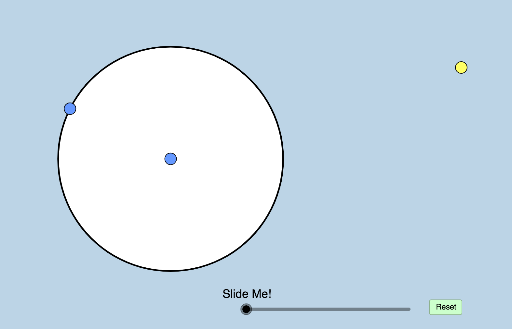
① This interactive GeoGebra example demonstrates the key properties of tangents drawn from an external point to a circle, such as equal tangent lengths and the perpendicularity between the tangent and the radius at the point of tangency. ② Core mathematical concepts include tangent lines, points of tangency, the tangent-length theorem, perpendicular relationships, angle bisectors, and properties of quadrilaterals formed by tangent points. ③ Construction highlights: using GeoGebra commands like Circle, Tangent, Intersect, Segment, Ray, Angle, Rotate, Dilate, and a button (button1) for interactivity, the applet lets users drag points to explore dynamic changes in the figure. ④ Suitable for middle or high school geometry classes, this resource serves both as a teacher demonstration tool and a student-led investigation for understanding tangent properties and their geometric proofs.
GeoGebra Commands & Parameters
Circle(O, B_1) → cSegment(O, B_1) → aPointIn(b) → ETangent(E, c) → d, eIntersect(c, e, 1) → BIntersect(c, d, 1) → ARay(E, A) → fRay(E, B) → gSegment(O, A) → hSegment(O, B) → iDilate(O, If[0 < j ≤ 1, 1 - j, 0], A) → A'Dilate(O, If[0 < j ≤ 1, 1 - j, 0], B) → A'_1Segment(O, A') → kSegment(O, A'_1) → lAngle(E, B, O) → αAngle(O, A, E) → βCircle(A, (0.25 * a)) → pCircle(B, (0.25 * a)) → qIntersect(p, h, 1) → FIntersect(q, i, 1) → GIntersect(p, f) → H, IIntersect(q, g) → J, KCircle(O, B_1) → tDilate(O, If[3.6 < j ≤ 4.6, 4.6 - j, 0], E) → C'Angle(A, E, B) → γRotate(B, If[5 < j ≤ 6, ((j - 5) * ((2 * π) - γ)), (2 * π) - γ], E) → D'_1Rotate(E, If[5 < j ≤ 6, ((j - 5) * ((2 * π) - γ)), (2 * π) - γ], E) → C'_1Segment(E, A) → nRay(A, I) → mRay(B, K) → g_1Rotate(E, If[5 < j ≤ 6, ((j - 5) * (-γ)), (-γ)], E) → C'_2Rotate(B, If[5 < j ≤ 6, ((j - 5) * (-γ)), (-γ)], E) → D'Rotate(I, If[1.5 < j ≤ 2.5, ((j - 1.5) * π / 2), π / 2], A) → I'Rotate(K, If[1.5 < j ≤ 2.5, ((-(j - 1.5)) * π / 2), ((-π)) / 2], B) → K'CircleSector(A, I, I') → rCircleSector(B, K', K) → sRotate(r, If[3.25 < j ≤ 4.25, ((j - 3.25) * π / 2), π / 2], A) → r'Rotate(s, If[3.25 < j ≤ 4.25, ((-(j - 3.25)) * π / 2), ((-π)) / 2], B) → s'Dilate(E, If[-1 < j ≤ 0, (-j), 0], A) → E'Dilate(E, If[-1 < j ≤ 0, (-j), 0], B) → E'_1Segment(E, E'_1) → f_1Segment(E, E') → i_1Line(E, A) → j_1Line(E, B) → k_1Circle(B, 2) → p_1Circle(A, 2) → q_1Intersect(q_1, j_1) → C, DIntersect(p_1, k_1) → L, MRay(A, D) → l_1Ray(B, M) → m_1Rotate(E, If[4.75 < j ≤ 5.75, ((j - 4.75) * γ), γ], E) → E'_2Rotate(E', If[4.75 < j ≤ 5.75, ((j - 4.75) * γ), γ], E) → E''Segment(E'_2, E'') → n_1