
Properties of a Rhombus by karabarmaths
Loading the math board and drawing, please wait…
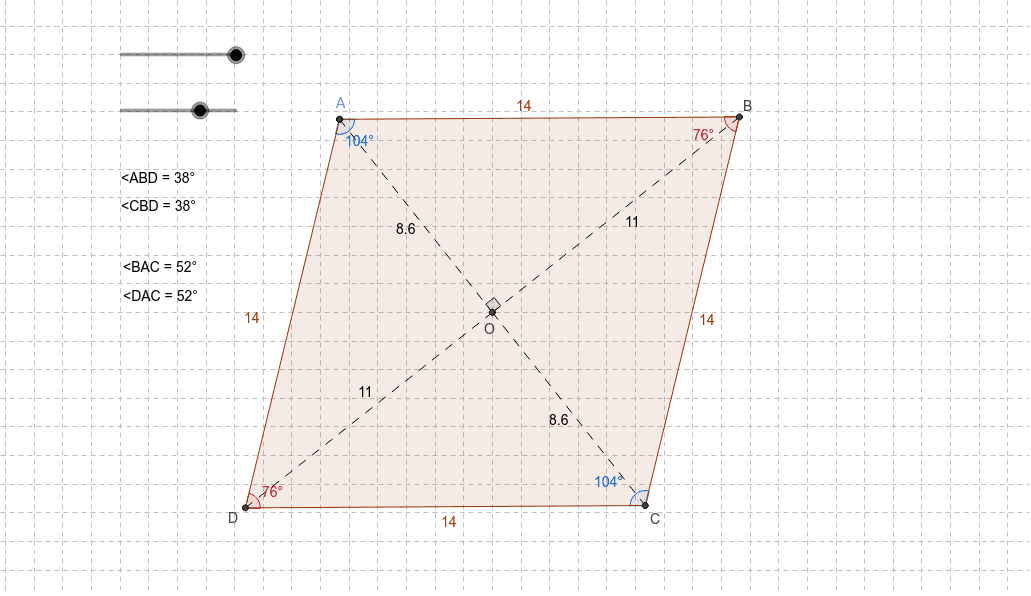
This example demonstrates the properties of a rhombus, including the perpendicular and bisecting diagonals and equal sides. Using GeoGebra commands such as Intersect, Circle, and Point, you can dynamically explore the properties of a rhombus. Suitable for middle school and above students or teachers.
GeoGebra Commands & Parameters
Intersect(xAxis, yAxis) → OCircle(O, r) → cCircle(O, r - a) → dPoint(d) → ALine(A, O) → bIntersect(d, b) → C_1, COrthogonalLine(O, b) → eIntersect(c, e) → D, BPolygon(A, B, C, D) → P, a_1, b_1, c_1, d_1Segment(A, O) → fSegment(O, C) → gSegment(O, B) → hSegment(O, D) → iAngle(B, O, A) → αAngle(D, A, B) → βAngle(B, C, D) → γAngle(A, B, D) → δAngle(C, D, B) → εAngle(C, D, A) → ζAngle(A, B, C) → ηAngle(A, B, D) → θAngle(D, B, C) → ιAngle(B, A, C) → κAngle(D, A, C) → λ
AI Drawing Prompt Reference
Draw a rhombus with its diagonals and sides. Start by drawing a circle centered at the origin, then draw another concentric circle with a different radius. Pick a point on the second circle as one vertex of the rhombus, draw a line through the origin from this point, and find the intersection with the second circle as another vertex. Draw a perpendicular line from the origin to this line, and find its intersection with the first circle as the other two vertices. Finally, connect these four points to form the rhombus and measure the angles.
The prompt above was compiled from the original drawing commands and is for reference only.