
Proof without words with Fibonacci numbers
Loading the math board and drawing, please wait…
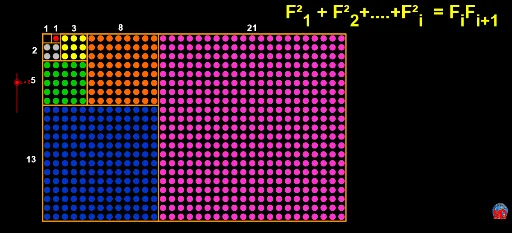
① This GeoGebra example demonstrates a visual proof without words for the Fibonacci identity involving sums of squares, using a geometric tiling of squares and triangles with side lengths equal to consecutive Fibonacci numbers. ② Core mathematical concepts include the Fibonacci sequence, sum-of-squares identities, geometric dissection, and the interplay between number theory and geometry. ③ The construction uses GeoGebra commands such as Sequence to generate Fibonacci numbers, Polygon to create squares, and Midpoint/Segment to partition triangles, with objects like liste1 through liste9 managing the polygonal sequence, resulting in a spiral-like arrangement that visually confirms the identity. ④ Suitable for high school to early university students, this example is ideal for teaching sequences, geometric proofs, and mathematical reasoning, and can serve as an engaging resource for exploring algebraic identities through visual patterns.
GeoGebra Commands & Parameters
Sequence(Sequence[C + (i, (-j)), i, 0, 1], j, 0, 1) → liste2Sequence(Sequence[B + (i + 1, (-j)), i, 0, 2], j, 0, 2) → liste3Sequence(Sequence[D + (i, (-j)), i, 0, 4], j, 0, 4) → liste4Sequence(Sequence[E + (i + 1, (-j)), i, 0, 7], j, 0, 7) → liste5Sequence(Sequence[F + (i, (-j)), i, 0, 12], j, 0, 12) → liste6Sequence(Sequence[G + (i + 1, (-j)), i, 0, 20], j, 0, 20) → liste7Sequence(Sequence[H + (i, (-j)), i, 0, 33], j, 0, 33) → liste8Sequence(Sequence[I + (i + 1, (-j)), i, 0, 54], j, 0, 54) → liste9Polygon(A + (-0.5, -0.5), B + (0.5, -0.5), B + (0.5, -2.5), A - (0.5, 2.5)) → poly1, b, c, d, ePolygon(B + (0.5, 0.5), B + (3.5, 0.5), B + (3.5, -2.5), B + (0.5, -2.5)) → poly2, f, g, h, iPolygon(D + (-0.5, 0.5), D + (4.5, 0.5), D + (4.5, -4.5), D + (-0.5, -4.5)) → poly3, j, k, l, mPolygon(E + (0.5, 0.5), E + (8.5, 0.5), E + (8.5, -7.5), E + (0.5, -7.5)) → poly4, n, p, q, rPolygon(F + (-0.5, 0.5), F + (12.5, 0.5), F + (12.5, -12.5), F + (-0.5, -12.5)) → poly5, s, t, a_1, b_1Polygon(G + (0.5, 0.5), G + (21.5, 0.5), G + (21.5, -20.5), G + (0.5, -20.5)) → poly6, c_1, d_1, e_1, f_1Polygon(H + (-0.5, 0.5), H + (33.5, 0.5), H + (33.5, -33.5), H + (-0.5, -33.5)) → poly7, g_1, h_1, i_1, j_1Polygon(I + (0.5, 0.5), I + (55.5, 0.5), I + (55.5, -54.5), I + (0.5, -54.5)) → poly8, k_1, l_1, m_1, n_1Polygon(B + (-0.5, -0.5), B + (-0.5, 0.5), B + (0.5, 0.5), B + (-0.5, 0.5)) → poly9, p_1, q_1, r_1, s_1Polygon(A + (-0.5, -0.5), A + (-0.5, 0.5), A + (0.5, 0.5), A + (-0.5, 0.5)) → poly10, t_1, a_2, b_2, c_2Midpoint(f) → JMidpoint(n) → KMidpoint(c_1) → LMidpoint(r_1) → MMidpoint(e) → NMidpoint(m) → OMidpoint(b_1) → PSegment(A + (-0.5, -0.5), A + (0.5, -0.5)) → d_2Segment(B + (0.5, 0.5), B + (0.5, -0.5)) → e_2Segment(B + (-0.5, -0.5), B + (0.5, -0.5)) → f_2Midpoint(a_2) → QSegment(B + (-0.5, 0.5), B + (0.5, 0.5)) → g_2Segment(A + (0.5, 0.5), A + (0.5, -0.5)) → h_2
AI Drawing Prompt Reference
Create a geometric illustration showing a visual proof of the Fibonacci identity involving sums of squares, composed of squares and triangles with side lengths equal to consecutive Fibonacci numbers. Start with the smallest square and expand outward, each square divided into two triangles, forming a spiral pattern. Use varying sizes of squares and triangles to demonstrate the geometric dissection and visually confirm the mathematical identity.
The prompt above was compiled from the original drawing commands and is for reference only.