
Constructing and Animating the Sierpinski Triangle Fractal
Loading the math board and drawing, please wait…
In collections
GeoGebra and Laser Cutting
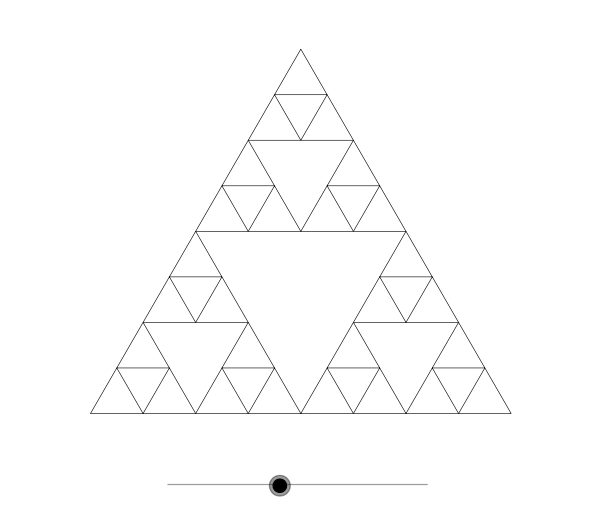
This example demonstrates how the Sierpinski Triangle fractal emerges by iteratively removing the middle sub-triangle from an initial triangle. As the iteration depth increases, the figure reveals a repeating self-similar pattern typical of fractal geometry. Key mathematical ideas include fractals and self-similarity, recursive/iterative construction, and the progressive refinement of a geometric set through repeated operations. Construction details from the GeoGebra command summary: Polygon is used to create the triangular/polygonal regions from key points (e.g., A, B, C and poly1); Join connects polygon edges to form the correct boundaries; Sequence generates iterative lists/objects that define the vertices or sub-triangles at each stage, organized into multiple lists (list1 through list16) to manage layers efficiently. The parameter n controls the number of iterations, enabling an interactive slider-like exploration of fractal depth. Suitable for advanced high school through early university, especially for lessons on recursion, geometric constructions, and parameterized visualization.
GeoGebra Commands & Parameters
Polygon(A, B, 3) → poly1, a, b, c, CJoin(Sequence[Sequence[{Element[Element[list1, i], j], Midpoint[Element[Element[list1, i], j], Element[Element[list1, i], Mod[j, 3] + 1]], Midpoint[Element[Element[list1, i], j], Element[Element[list1, i], Mod[j + 1, 3] + 1]]}, j, 1, 3], i, 1, CountIf[x ≠ 3, list1]]) → list2Join(Sequence[Sequence[{Element[Element[list2, i], j], Midpoint[Element[Element[list2, i], j], Element[Element[list2, i], Mod[j, 3] + 1]], Midpoint[Element[Element[list2, i], j], Element[Element[list2, i], Mod[j + 1, 3] + 1]]}, j, 1, 3], i, 1, CountIf[x ≠ 3, list2]]) → list3Join(Sequence[Sequence[{Element[Element[list3, i], j], Midpoint[Element[Element[list3, i], j], Element[Element[list3, i], Mod[j, 3] + 1]], Midpoint[Element[Element[list3, i], j], Element[Element[list3, i], Mod[j + 1, 3] + 1]]}, j, 1, 3], i, 1, CountIf[x ≠ 3, list3]]) → list4Join(Sequence[Sequence[{Element[Element[list4, i], j], Midpoint[Element[Element[list4, i], j], Element[Element[list4, i], Mod[j, 3] + 1]], Midpoint[Element[Element[list4, i], j], Element[Element[list4, i], Mod[j + 1, 3] + 1]]}, j, 1, 3], i, 1, CountIf[x ≠ 3, list4]]) → list5Join(Sequence[Sequence[{Element[Element[list5, i], j], Midpoint[Element[Element[list5, i], j], Element[Element[list5, i], Mod[j, 3] + 1]], Midpoint[Element[Element[list5, i], j], Element[Element[list5, i], Mod[j + 1, 3] + 1]]}, j, 1, 3], i, 1, CountIf[x ≠ 3, list5]]) → list6Join(Sequence[Sequence[{Element[Element[list6, i], j], Midpoint[Element[Element[list6, i], j], Element[Element[list6, i], Mod[j, 3] + 1]], Midpoint[Element[Element[list6, i], j], Element[Element[list6, i], Mod[j + 1, 3] + 1]]}, j, 1, 3], i, 1, CountIf[x ≠ 3, list6]]) → list7Join(Sequence[Sequence[{Element[Element[list7, i], j], Midpoint[Element[Element[list7, i], j], Element[Element[list7, i], Mod[j, 3] + 1]], Midpoint[Element[Element[list7, i], j], Element[Element[list7, i], Mod[j + 1, 3] + 1]]}, j, 1, 3], i, 1, CountIf[x ≠ 3, list7]]) → list8Sequence(Polygon[Element[list1, i]], i, 1, CountIf[x ≠ 3, list1]) → list9Sequence(Polygon[Element[list2, i]], i, 1, CountIf[x ≠ 3, list2]) → list10Sequence(Polygon[Element[list3, i]], i, 1, CountIf[x ≠ 3, list3]) → list11Sequence(Polygon[Element[list4, i]], i, 1, CountIf[x ≠ 3, list4]) → list12Sequence(Polygon[Element[list5, i]], i, 1, CountIf[x ≠ 3, list5]) → list13Sequence(Polygon[Element[list6, i]], i, 1, CountIf[x ≠ 3, list6]) → list14Sequence(Polygon[Element[list7, i]], i, 1, CountIf[x ≠ 3, list7]) → list15Sequence(Polygon[Element[list8, i]], i, 1, CountIf[x ≠ 3, list8]) → list16
AI Drawing Prompt Reference
Start with an equilateral trianglecars and repeatedly subdivide it by connecting the midpoints of each side, removing the central smaller triangle at each step. This process is iterated multiple times, with each iteration applying the same subdivision rule to all remaining triangles, creating a progressively finer self-similar pattern. The final figure consists of nested triangular layers representing successive iterations, showcasing the recursive nature of fractal geometry.
The prompt above was compiled from the original drawing commands and is for reference only.