
Special Points in a Triangle: Construction and Relationships
Loading the math board and drawing, please wait…
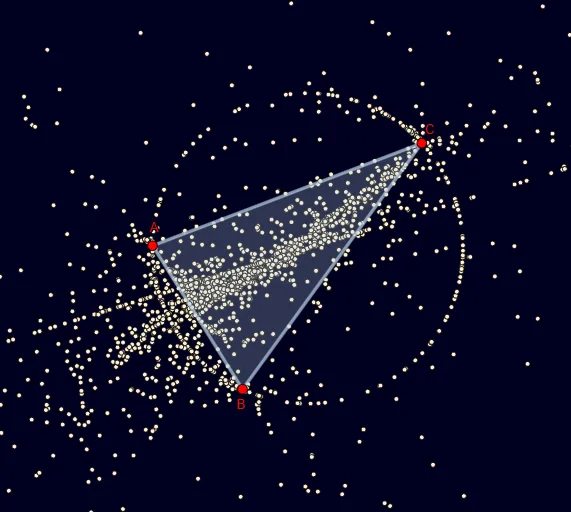
This GeoGebra example demonstrates how to locate and visualize “special points” inside or associated with a triangle, emphasizing the geometric structure that emerges from constraints such as distance conditions, parallelism/translation ideas, and corresponding relationships. The key mathematics includes triangle special points (construction/intersection-type ideas), similar triangles and angle correspondence, and the use of translation (parallel shift) as a transformation perspective. Construction-wise, it is built from parameter-driven steps: the construct summary indicates the use of Polygon to form the triangle from vertices A, B, C, and Sequence to iterate or generate a parameterized set of points or labels. The involved objects include n and Text1 for iteration/annotation, parameters d1, a, b, c capturing geometric measures or auxiliary quantities, P representing the special point, and d recording a key computed/used quantity such as a distance or related measure. Suitable for middle-school geometry practice, contest prep, and classroom demonstrations focusing on transformation geometry and similarity-based reasoning.
GeoGebra Commands & Parameters
Polygon(A, B, C) → d1, c, a, bSequence(TriangleCenter[A, B, C, k], k, 1, n) → P
AI Drawing Prompt Reference
Draw a triangle using three given vertices and outline its polygonal boundary, showing the associated side-length measures. Next, construct a family of “special points” determined by the triangle’s center-type definition, taking an index k that runs from 1 to n; generate the corresponding points sequentially so the key point inside or related to the triangle becomes visible. Add brief text annotations for the constructed points and keep track of a key distance or related metric used by the construction to reflect the geometric relationship between the points and the triangle.
The prompt above was compiled from the original drawing commands and is for reference only.