
Proof Without Words: Visual Demonstration of the Pythagorean Theorem
Loading the math board and drawing, please wait…
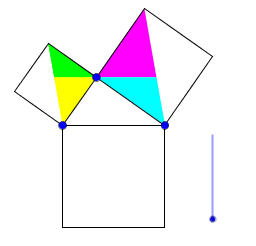
This GeoGebra example presents a classic 'proof without words' for the Pythagorean theorem through an interactive geometric construction with draggable points and a slider. The core mathematical concept is the Pythagorean theorem, intertwined with linear functions, cosine, multiplication, and square roots. The construction utilizes GeoGebra commands such as Point, Mirror, Semicircle, Polygon, Line, Segment, Intersect, Dilate, Vector, Translate, Midpoint, and Rotate, creating semicircles, polygons, segments, and mirrored points, with a slider t controlling dynamic changes. Suitable for middle and high school mathematics classrooms, this resource helps students visually grasp the area relationships underlying the theorem and encourages them to formulate their own proof by observing the dynamic figure. It is ideal for inquiry-based learning and conceptual reinforcement.
GeoGebra Commands & Parameters
Point(yAxis) → AMirror(B, A) → B'Semicircle(B, B') → cPoint(c) → CPolygon(B, C, 4) → poly1, a, b, d, e, D, EPolygon(C, B', 4) → poly2, f, g, h, i, F, GPolygon(B', B, 4) → poly3, j, k, l, m, H, ILine(C, j) → nSegment(D, B) → pSegment(G, B') → qIntersect(n, p) → JIntersect(n, q) → KPolygon(D, J, C) → poly4, c_1, d_1, j_1Polygon(B, J, C) → poly5, c_2, b_1, j_2Polygon(C, K, G) → poly6, g_1, c_3, k_1Polygon(K, B', C) → poly7, c_4, k_2, b'Dilate(J, If[t ≤ 1, 1 - t, 0], K) → J'Vector(J, J') → uTranslate(D, u) → D'Translate(J, u) → J'_1Translate(C, u) → C'Polygon(D', J'_1, C') → poly4', c', d', j'_1Translate(B, u) → B'_1Translate(J, u) → J'_2Translate(C, u) → C'_1Polygon(B'_1, J'_2, C'_1) → poly5', c'_1, b'_1, j'_2Midpoint(D, B) → LRotate(C, If[1 < t ≤ 2, ((-(t - 1)) * π / 2), -1.5707963267948966], L) → C'_2Rotate(K, If[1 < t ≤ 2, ((-(t - 1)) * π / 2), -1.5707963267948966], L) → K'Rotate(G, If[1 < t ≤ 2, ((-(t - 1)) * π / 2), -1.5707963267948966], L) → G'Polygon(C'_2, K', G') → poly6', g', c'_2, k'Rotate(D', If[1 < t ≤ 2, ((-(t - 1)) * π / 2), -1.5707963267948966], L) → D''Rotate(J'_1, If[1 < t ≤ 2, ((-(t - 1)) * π / 2), -1.5707963267948966], L) → MRotate(C', If[1 < t ≤ 2, ((-(t - 1)) * π / 2), -1.5707963267948966], L) → C''Polygon(D'', M, C'') → poly4'', c'', d'', m_1Dilate(C, If[2 < t ≤ 3, 3 - t, 0], B) → C'_3Vector(C, C'_3) → vTranslate(K, v) → K'_1Translate(B', v) → B''Translate(C, v) → C'_4Polygon(K'_1, B'', C'_4) → poly7', c'_4, k'_1, b''Translate(B'_1, v) → NTranslate(J'_2, v) → OTranslate(C'_1, v) → PPolygon(N, O, P) → poly5'', p_1, n_1, oMidpoint(H, B') → QRotate(D'', If[3 < t ≤ 4, ((-(t - 3)) * π), -3.141592653589793], Q) → D'''Rotate(M, If[3 < t ≤ 4, ((-(t - 3)) * π), -3.141592653589793], Q) → M'Rotate(C'', If[3 < t ≤ 4, ((-(t - 3)) * π), -3.141592653589793], Q) → C'''Polygon(D''', M', C''') → poly4''', c''', d''', m'Rotate(C'_2, If[3 < t ≤ 4, ((-(t - 3)) * π), -3.141592653589793], Q) → RRotate(K', If[3 < t ≤ 4, ((-(t - 3)) * π), -3.141592653589793], Q) → K''Rotate(G', If[3 < t ≤ 4, ((-(t - 3)) * π), -3.141592653589793], Q) → G''Polygon(R, K'', G'') → poly6'', g'', r, k''Rotate(K'_1, If[3 < t ≤ 4, ((-(t - 3)) * π), -3.141592653589793], Q) → SRotate(B'', If[3 < t ≤ 4, ((-(t - 3)) * π), -3.141592653589793], Q) → B'''Rotate(C'_4, If[3 < t ≤ 4, ((-(t - 3)) * π), -3.141592653589793], Q) → TPolygon(S, B''', T) → poly7'', t_1, s, b'''Rotate(N, If[3 < t ≤ 4, ((-(t - 3)) * π), -3.141592653589793], Q) → N'Rotate(O, If[3 < t ≤ 4, ((-(t - 3)) * π), -3.141592653589793], Q) → O'Rotate(P, If[3 < t ≤ 4, ((-(t - 3)) * π), -3.141592653589793], Q) → P'Polygon(N', O', P') → poly5''', p', n', o'
AI Drawing Prompt Reference
A visual proof of the Pythagorean theorem. The figure includes a right triangle ABC, point B' as the mirror of A, a semicircle c with diameter BB', and point C on the semicircle. Points D, E, etc. are vertices of squares. Line n connects C to a vertex of polygon poly3, and points J and K are intersections with lines p and q. Point L is the midpoint of D and B. The figure is dynamic, controlled by a slider t, with translations and rotations forming triangles and squares to illustrate area relationships.
The prompt above was compiled from the original drawing commands and is for reference only.