
Proof Without Words: Pythagorean Theorem by Steve Phelps (3)
Loading the math board and drawing, please wait…
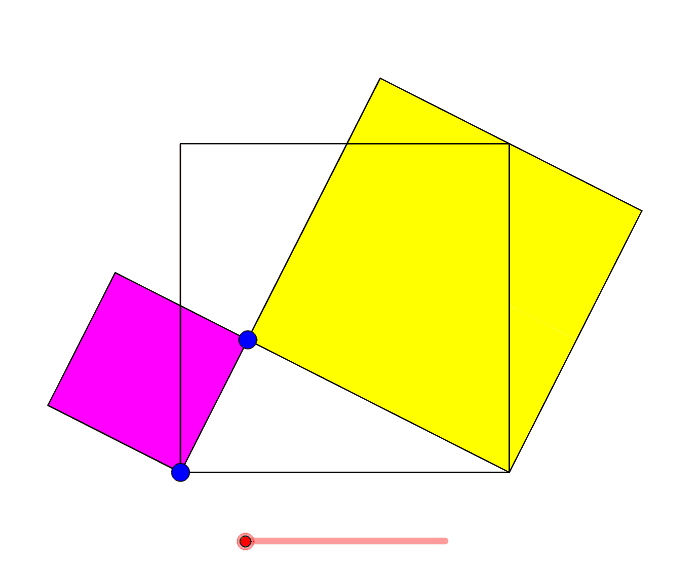
This example visually demonstrates the Pythagorean Theorem by dragging points and sliders. It involves concepts like rectangles and vectors. Using GeoGebra commands such as constructing rectangles, rotating, and translating, it dynamically shows that the area of the square on the hypotenuse of a right triangle is equal to the sum of the areas of the squares on the other two sides. Suitable for middle school and above students learning geometric proofs.
GeoGebra Commands & Parameters
Point(xAxis) → AIntersect(xAxis, yAxis) → BCircleArc(B, D, A) → cPoint(c) → EPolygon(A, E, 4) → poly1, a, b, d, e, F, GPolygon(E, C, 4) → poly2, f, g, h, i, H, IPolygon(A, C, 4) → poly3, j, k, l, m, J, KIntersect(b, m) → LIntersect(i, l) → MPolygon(A, G, F, L) → poly4, a_1, g_1, f_1, l_1Polygon(M, I, J) → poly5, j_1, m_1, i_1Polygon(J, C, H) → poly6, h_1, j_2, c_1Polygon(A, E, L) → poly7, l_2, a_2, e_1Polygon(E, M, J, C) → poly8, e_2, m_2, j_3, c_2If(n < 1, n, 1) → r1Rotate(A, (-(((r1 * 90))°)), A) → A'Rotate(G, (-(((r1 * 90))°)), A) → G'Rotate(F, (-(((r1 * 90))°)), A) → F'Rotate(L, (-(((r1 * 90))°)), A) → L'Polygon(A', G', F', L') → poly4', a', g', f', l'Dilate(J, If[1 ≤ n < 2, 2 - n, If[n ≥ 2, 0, 1]], C) → J'Vector(J, J') → uTranslate(M, u) → M'Translate(I, u) → I'Translate(J, u) → J'_1Polygon(M', I', J'_1) → poly5', j'_1, m', i'Midpoint(A, J) → NVector(A, L) → vTranslate(C, v) → C'Vector(A, E) → wTranslate(C, w) → C'_1Polygon(C, C', C'_1) → poly9, c'_1, c_3, c'Polygon(C', J, H, C'_1) → poly10, c'_2, j_4, h_2, c'_3Dilate(J, If[2 ≤ n < 3, 3 - n, If[n ≥ 3, 0, 1]], K) → J'_2Vector(J, J'_2) → pTranslate(C', p) → C''Translate(J, p) → J'_3Translate(H, p) → H'Translate(C'_1, p) → OPolygon(C'', J'_3, H', O) → poly10', c'', j'_3, h', oIf(3 ≤ n ≤ 4, n - 3, 0) → r2Rotate(C, (-(((r2 * 90))°)), J) → C'_2Rotate(C', (-(((r2 * 90))°)), J) → C''_1Rotate(C'_1, (-(((r2 * 90))°)), J) → PPolygon(C'_2, C''_1, P) → poly9', p_1, c'_4, c''_1