
Proof Without Words: Dynamic Visualization of the Pythagorean Theorem
Loading the math board and drawing, please wait…
In collections
Similarity & Right Triangle Trigonometry
Similarity, Right Triangles, and Trigonometry (SRT) Cluster
Proofs Without Words
Proofs Without Words
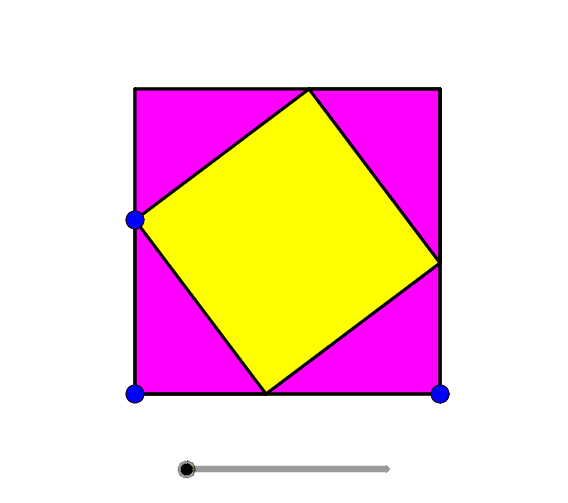
This GeoGebra example presents an interactive, wordless proof of the Pythagorean theorem through draggable points and a slider. It demonstrates the geometric relationship that in a right triangle, the sum of the areas of the squares on the two legs equals the area of the square on the hypotenuse. The construction uses commands such as Point, Polygon, Midpoint, Mirror, Rotate, Dilate, Vector, Translate, Circle, Intersect, and Segment to create and transform multiple congruent or similar triangles and polygons (poly1 to poly4). By dragging points and adjusting the slider, learners can observe how the shapes rearrange to visually confirm the theorem. This resource is ideal for middle or high school mathematics classes, serving as an engaging tool for teaching geometric proofs, spatial reasoning, and the Pythagorean theorem in a visual, inquiry-based manner.
GeoGebra Commands & Parameters
Point(xAxis) → APoint(xAxis) → BPolygon(A, B, 4) → poly1, a, b, c, d, C, DPoint(d) → EMidpoint(D, B) → FMirror(E, F) → E'Rotate(E', 90*°, F) → E''Mirror(E'', F) → E'''Polygon(A, E, E''') → poly2, e''', a_1, ePolygon(E, D, E'') → poly3, e'', e_1, d_1Polygon(E'', C, E') → poly4, e', e''_1, c_1Rotate(E'', (-((90° * f))), E'') → E'''_1Rotate(C, (-((90° * f))), E'') → C'Rotate(E', (-((90° * f))), E'') → E''_1Polygon(E'''_1, C', E''_1) → poly4', e''_2, e'''_2, c'Dilate(E''', 1 - f, B) → GVector(E''', G) → uTranslate(A, u) → A'Translate(E, u) → E'_1Translate(E''', u) → HPolygon(A', E'_1, H) → poly2', h, a', e'_2Circle(G, Segment[E'_1, A']) → gIntersect(g, b, 1) → ICircle(I, Segment[C', E'']) → kCircle(G, Segment[E''_1, E'']) → pIntersect(k, p, 2) → JPolygon(G, I, J) → poly5, j, g_1, iSegment(C, B) → l
AI Drawing Prompt Reference
Draw a square with two vertices on the x-axis. Pick a point on one side of the square)Skip to construct three adjacent triangles that can rotate around a common point. Use a slider to control the rotation angle, causing some triangles to rotate and others to translate, forming two smaller squares and one larger square that together demonstrate the Pythagorean theorem. Include draggable points, a slider, multiple polygons, circles, and auxiliary segments for a dynamic geometric proof.
The prompt above was compiled from the original drawing commands and is for reference only.