
Proof of Pythagorean Theorem by Rotation
Loading the math board and drawing, please wait…
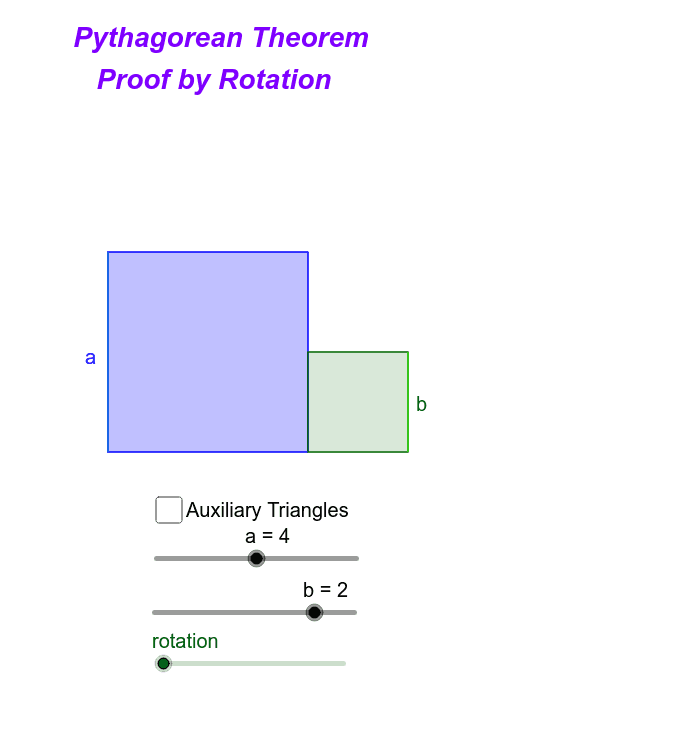
This example demonstrates the Pythagorean Theorem through rotation, illustrating that the square of the hypotenuse equals the sum of the squares of the other two sides in a right triangle. Core math concepts include rotation, congruent triangles, and geometric transformations. Construction highlights the use of GeoGebra commands/objects: Intersect, Circle, Polygon, Segment, Rotate. Suitable for high school students or geometric transformation lessons.
GeoGebra Commands & Parameters
Intersect(xAxis, yAxis) → ACircle(A, a) → cIntersect(c, xAxis, 2) → BCircle(B, b) → dIntersect(d, xAxis, 2) → CPolygon(A, B, 4) → poly1, e, f, g, h, D, EPolygon(B, C, 4) → poly2, i, j, k, l, F, GCircle(A, b) → pIntersect(p, e, 1) → HSegment(E, H) → mSegment(H, F) → nPolygon(E, H, A) → poly3, a_1, e_1, h_1Polygon(H, F, C) → poly4, c_1, h_2, f_1Rotate(E, rotation, E) → E'Rotate(H, rotation, E) → H'Rotate(A, rotation, E) → A'Polygon(E', H', A') → poly3', a', e', h'Rotate(F, rotation, F) → F'Rotate(E, (3 * rotation), E) → E'_1Rotate(H, (3 * rotation), F) → H'_2Rotate(F, (3 * rotation), F) → F'_1Rotate(C, (3 * rotation), F) → C'_1Polygon(H'_2, F'_1, C'_1) → poly4'_1, c'_1, h'_2, f'_1
AI Drawing Prompt Reference
Draw a right triangle with the intersection of the x and y axes as the right angle vertex. Draw two circles centered at the right angle vertex with the lengths of the two legs as radii, intersecting the x-axis at two points. Connect these points to form the triangle. Then, draw two smaller triangles by connecting the intersection points of the circles with the x-axis. Rotate these smaller triangles around the right angle vertex and observe the relationship between the rotated shapes and the original triangle to demonstrate the Pythagorean theorem.
The prompt above was compiled from the original drawing commands and is for reference only.