
Proof of a^3 - b^3 without words
Loading the math board and drawing, please wait…
In collections
Algebraic puzzles for binomial formula
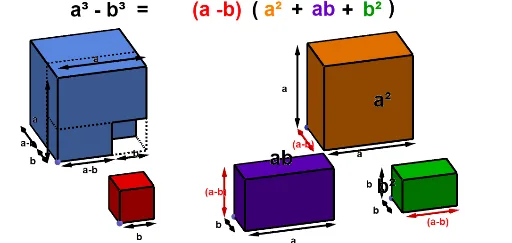
This example visually demonstrates the proof of the cube difference formula a^3 - b^3 using geometric shapes. Key mathematical concepts include cube difference, geometric construction, and coordinate geometry. Using GeoGebra commands such as PointIn, Cube, Polygon, and Vector, a 3D model is constructed to illustrate the geometric meaning of the cube difference formula. Suitable for students at the junior high school level and above.
GeoGebra Commands & Parameters
PointIn(f) → APoint(Circle[B, Distance[C, B], Segment[C, B]]) → LCube(C, B, L) → c, M, faceLMQP, faceNOPQ, arêteCM_1, arêteBC, arêteBL, arêteLM, arêteCN, arêteMQ, arêteNQ, arêteNO, N, arêteBO, arêteOP_1, arêteLP, arêtePQ, O, P, Q, faceBCML, faceCMQN, faceBCNO, faceBLPOPolygon(E, L, M, C, A, D) → poly1, e, l, m, c_1, a_1, dPolygon(T, U, O, N, C, A) → poly2, t, u, o_3, n, c_2, a_2Polygon(U, R, E, L, P, O) → poly3, u_1, r, e_1, l_1, p, o_1Polygon(P, O, N, Q) → q1, p_1, o_2, n_1, qPolygon(Q, N, C, M) → q2, q_1, n_2, c_3, m_1Polygon(R, S, D, E) → q3, r_1, s, d_1, e_2Polygon(S, T, A, D) → q4, s_1, t_1, a_3, d_2Polygon(U, T, S, R) → q5, u_2, t_2, s_2, r_2PointIn(f) → VVector(C, V) → vTranslate(c, Vector[(If[Animation ≤ 10, Animation / 10, 1] * v)]) → c'Polygon(Q, P, L, M) → q6, q_2, p_2, l_2, m_2Segment(W, C_1) → gSegment(C_1, A_1) → hSegment(B_1, Z) → iSegment(Z, O) → jSegment(W, L) → kPrism(L, A_1, D, E, W) → w, D_1, arête4, arête1, arêteDE, arêteEL, arêteLW, arête7, arête2, arête3, arête5, arête8, E_1, arête9, arête6, F_1, face1, face5, face3, face2, face4, face6Prism(B_1, Z, O, P, D_1) → b_1, G_1, arête13, arêteOZ, arêteOP, arête11, arête15, arête14, arête10, arête12, arête16, arête18, H_1, arête19, arête17, I_1, face7, face11, face9, face8, face10, face12Prism(A_1, A, C, M, B_1) → f_1, J_1, arête20, arêteAC, arêteCM, arête23, arête25, arête21, arête22, arête24, arête26, arête28, K_1, arête29, arête27, L_1, face13, face15, face14, face16, face17, face18PointIn(f) → M_1Vector(D, M_1) → v_1PointIn(f) → N_1PointIn(f) → O_1Vector(B_1, N_1) → w_1Translate(b_1, Vector[((Animation - 10) / 10 * w_1)]) → g_1Vector(A_1, O_1) → h_1Translate(f_1, Vector[((Animation - 10) / 10 * h_1)]) → i_1Translate(c, Vector[(If[Animation ≤ 10, Animation / 10, 1] * v)]) → c'_1Translate(b_1, Vector[((Animation - 10) / 10 * w_1)]) → j_1Translate(w, Vector[((Animation - 10) / 10 * v_1)]) → w'_1Translate(f_1, Vector[((Animation - 10) / 10 * h_1)]) → k_1Translate(w, Vector[((Animation - 10) / 10 * v_1)]) → w'Midpoint(R_1, S_1) → Z_1Vector(Z_1, S_1) → v_2Vector(Z_1, R_1) → w_2Midpoint(T_1, U_1) → A_2Vector(A_2, U_1) → b_2Vector(A_2, T_1) → f_2Midpoint(B_2, Q_1) → C_2Vector(C_2, Q_1) → g_2Vector(C_2, B_2) → h_2Midpoint(D_2, B_2) → E_2Vector(E_2, B_2) → i_2Vector(E_2, D_2) → j_2Midpoint(P_1, Q_1) → F_2Vector(F_2, P_1) → k_2Vector(F_2, Q_1) → u_3Midpoint(W_1, V_1) → G_2Vector(G_2, W_1) → v_3Vector(G_2, V_1) → w_3Segment(C, B) → f_3Segment(L, B) → g_3Segment(O, B) → h_3Midpoint(M_2, N_2) → W_2Vector(W_2, N_2) → b_3Vector(W_2, M_2) → d_3Midpoint(P_2, Q_2) → Z_2Midpoint(U_2, V_2) → A_3Midpoint(K_2, J_2) → B_3Vector(B_3, K_2) → e_3Vector(B_3, J_2) → i_3Vector(Z_2, Q_2) → j_3Vector(Z_2, P_2) → k_3Midpoint(R_2, S_2) → C_3Midpoint(T_2, R_2) → D_3Midpoint(H_2, I_2) → E_3Vector(E_3, I_2) → l_3Vector(E_3, H_2) → m_3Vector(D_3, T_2) → n_3Vector(D_3, R_2) → p_3Vector(C_3, S_2) → q_3Vector(C_3, R_2) → r_3Vector(A_3, V_2) → s_3Vector(A_3, U_2) → t_3Midpoint(J_2, L_2) → F_3Vector(F_3, L_2) → u_4Vector(F_3, J_2) → v_4Midpoint(O_2, H_2) → G_3Vector(G_3, O_2) → w_4Vector(G_3, H_2) → a_4Midpoint(U_1, H_3) → I_3Vector(I_3, H_3) → b_4Vector(I_3, U_1) → c_4PointIn(w') → J_3PointIn(k_1) → K_3PointIn(j_1) → L_3
AI Drawing Prompt Reference
Create a geometric proof of the cube difference formula a^3 - b^3, showing the difference between two cubes. Start by constructing a cube, then use geometric shapes and coordinate geometry to break down the cube difference into multiple parts, represented by polygons and lines in different colors. The final image should include various geometric bodies and vectors, clearly demonstrating the geometric meaning of the cube difference formula, suitable for junior high school students and above.
The prompt above was compiled from the original drawing commands and is for reference only.