
Projection of a Cube onto a Plane
Loading the math board and drawing, please wait…
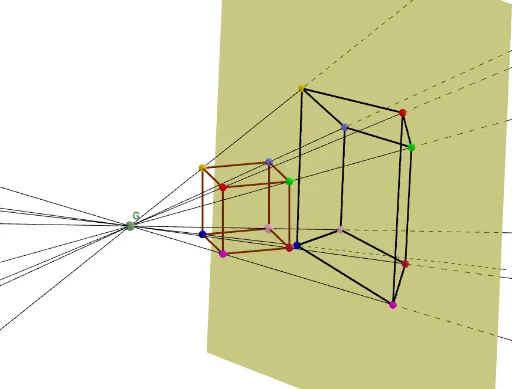
This example demonstrates the process and result of projecting a cube onto a specified plane in 3D space. Key math concepts include vectors, parametric curves, spatial geometry, and projection transformations. The construction utilizes GeoGebra commands and objects like Point, Cube, Intersect, Sphere, OrthogonalPlane, Line, and Segment as outlined in the summary. Suitable for high school students and above learning spatial geometry, vector projections, and 3D transformations, as well as university-level introductory geometry courses.
GeoGebra Commands & Parameters
Point(Circle[(1, -1, -1), Distance[(-1, -1, -1), (1, -1, -1)], Segment[(-1, -1, -1), (1, -1, -1)]]) → ACube((-1, -1, -1), (1, -1, -1), A) → a, B, faceABFE, faceCDEF, edge2, edge1, edge4, edgeAB, edge3, edgeBF, edgeCF, edgeCD, C, edge5, edgeDE, edgeAE, edgeEF, D, E, F, face1, face3, face2, face4Intersect(yAxis, zAxis) → HSphere(H, G) → bOrthogonalPlane((-G), Line[G, (-G)]) → cLine(G, E) → fLine(G, F) → gLine(G, D) → hLine(G, C) → iLine(G, A) → jLine(G, I) → kLine(G, J) → lLine(G, B) → mIntersect(m, c) → KIntersect(l, c) → LIntersect(k, c) → MIntersect(j, c) → NIntersect(i, c) → OIntersect(h, c) → PIntersect(g, c) → QIntersect(f, c) → RSegment(O, Q) → nSegment(O, L) → pSegment(Q, K) → qSegment(K, L) → rSegment(K, N) → sSegment(N, R) → tSegment(R, Q) → dSegment(P, O) → eSegment(P, R) → f_1Segment(M, L) → g_1Segment(M, P) → h_1Segment(M, N) → i_1