
Projectile Motion of a Rocket Using Parametric Equations
Loading the math board and drawing, please wait…
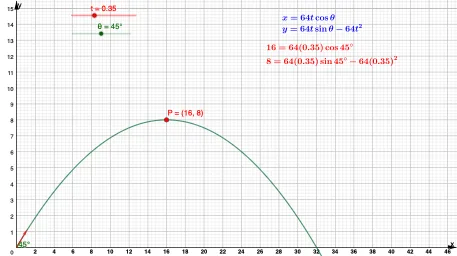
This GeoGebra example vividly demonstrates the projectile motion of a rocket under gravity using parametric equations, bridging physics and mathematics. The core mathematical concepts include parametric equations, trigonometric functions, vectors, and motion decomposition, where the position is controlled by parameter t, and the velocity vector v and acceleration vector a jointly determine the trajectory shape. The construction uses the CurveCartesian command to plot the parametric curve, along with Point, Intersect, Vector, Tangent, and Angle commands to create key points, intersections, velocity tangents, and angle labels. A slider dynamically adjusts the launch angle θ and initial speed, while SurdText displays exact values. This example is suitable for high school or pre-university students learning analytic geometry, trigonometric applications, and projectile motion in physics. It also serves as an effective classroom demonstration tool, helping students intuitively understand how parametric equations describe two-dimensional motion and the essential role of vectors in motion analysis.
GeoGebra Commands & Parameters
CurveCartesian(((64 * t) * cos(θ)), ((64 * t) * sin(θ)) - (64 * t^(2)), t, 0, 2) → aPoint(xAxis) → BIntersect(yAxis, a) → CVector(C, B) → vTangent(C, a) → fPoint(f) → AVector(C, A) → uAngle(B, C, A) → αSurdText(P) → text3