
Prism Model Demonstration
Loading the math board and drawing, please wait…
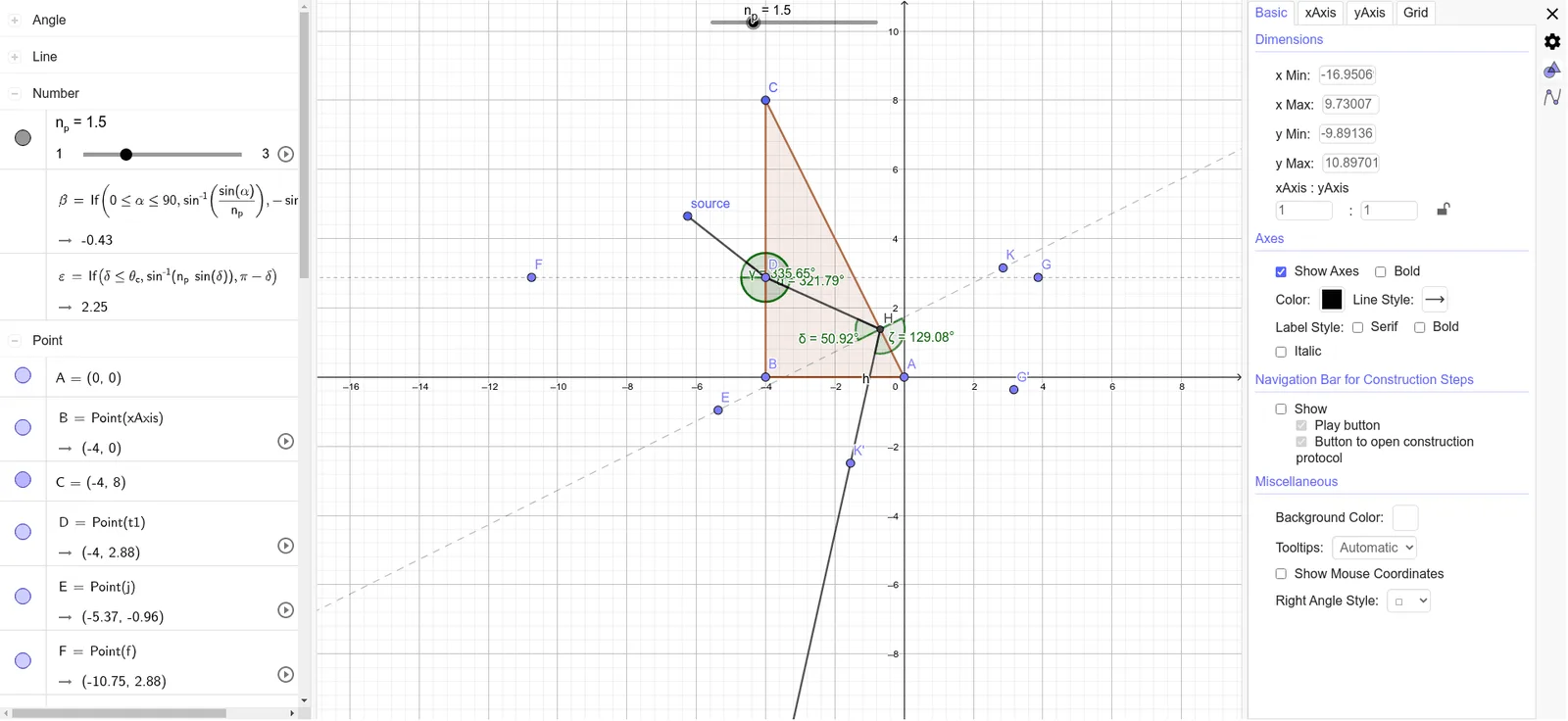
This example demonstrates the 3D geometric construction and properties of a prism. It involves core math concepts like solid geometry, integral calculus, root calculations, arithmetic operations, cuboids, and conic sections. The construction uses GeoGebra commands and objects such as points, polygons, orthogonal lines, lines, angles, segments, conditional statements, rotations, rays, and intersections. Suitable for high school students and math enthusiasts learning solid geometry and integral calculus.
GeoGebra Commands & Parameters
Point(xAxis) → BPolygon(A, B, C) → t1, c, a, bPoint(t1) → DOrthogonalLine(D, a) → fLine(source, D) → gPoint(f) → FAngle(F, D, source) → αPoint(f) → GSegment(source, D) → ray1If(0 ≤ α ≤ 90, asin(sin(α) / n_p), (-asin(sin(α) / n_p))) → βRotate(G, β, D) → G'Angle(G, D, G') → γRay(D, G') → ray_{inside}Intersect(b, ray_{inside}) → HOrthogonalLine(H, b) → jIntersect(ray_{inside}, c) → IOrthogonalLine(I, c) → kIntersect(ray_{inside}, c) → JSegment(D, H) → ray_{2visible}Point(j) → EAngle(D, H, E) → δIf(δ ≤ θ_{c}, asin((n_p * sin(δ))), π - δ) → εPoint(j) → KRotate(K, (-ε), H) → K'Angle(K', H, K) → ζRay(H, K') → h